Monthly Archives: September 2021

Glass Bakeware

Glass 101 – About the Types of Glass Used in the Kitchen

About the Types of Glass Used in the Kitchen
Soda-Lime vs Tempered vs Borosilicate Glass

There is a growing trend to move away from plastic food containers and metal bakeware, and there are many good reasons for doing so. However, the more we explore this option, the more it can become confusing. There are different types of glassware available. So, the question remains…Which one is best for me? This article explores the different types of glassware available today, so that you can make an informed decision on what type of glassware is best for you.

About the Different Types of Glass for Kitchen Use
Not all glass is created equal. However, each type has its own advantages and potential drawbacks. Which type of glass is best to buy will depend on your intended use for the item itself. The following should help you when shopping for glass items for your kitchen.

Components of Glass. All types of glass contain silicon dioxide, boron trioxide, sodium oxide, and aluminum oxide. However, the proportions of each chemical vary between glass types. The chemical composition affects the strength and melting points of glass. There are three types of glass that can be found in the kitchen: Soda-lime, tempered, and borosilicate glass.

About the Annealing Process. Annealing is a process of heating and cooling glass at a controlled rate during manufacturing. This step improves the glass’ durability and helps to reduce internal stresses that could cause breakage when the glass is heated and cooled during normal use. Annealed glass may be referred to as non-tempered glass or float glass. Annealed glass is not as strong as tempered glass. When annealed glass gets broken, it breaks into sharp, jagged pieces that could hurt someone nearby. When tempered glass gets broken, it breaks into small, smooth, relatively harmless pieces.

Since annealed glass does not go through extensive processing, it is cheaper to make than tempered glass. Annealed glass has optimal versatility for the manufacturer, so it can be crafted in many styles and designs, allowing it to be customized in many ways.

Soda-Lime Glass
Soda-lime glass is the most common type of glass. It may also be referred to as “soda-lime-silica glass” and may also be referred to as “annealed glass” since it is put through the annealing process. This glass is usually used for windowpanes, light bulbs, and glass containers like bottles and jars for beverages, food, and some commodities. Mason jars are made of soda-lime, annealed glass. Because of its chemical makeup, soda-lime glass is not as strong as other types of glass and will break easily when subjected to being bumped, or sudden extreme temperature changes (also known as thermal shock). While any glass can break with extreme sudden temperature changes or mechanical bumps, soda-lime glass will break the easiest under such conditions. It is relatively inexpensive to make, so it would be the preferred glass to manufacture. About ninety percent of manufactured glass is soda-lime glass. Soda-lime glass does not contain as much silicone dioxide (69%) as does borosilicate glass (80.6%).

Soda-lime glass is smooth and nonporous, allowing it to be easily cleaned. It resists chemicals in water solutions, so they will not contaminate the contents nor affect the flavor of anything stored in the glass. However, soda-lime glass does not tolerate very high temperatures, sudden temperature changes, or being bumped mechanically without cracking, chipping or breaking. For example, it can break when exposed to a sudden temperature change, such as when pouring very hot liquid into a cool glass.

Tempered Glass
Tempered glass is soda-lime glass that has been specially treated to make it stronger and more durable. In the manufacturing process, soda-lime glass is subjected to extremely high temperatures, followed by a few seconds of a high-pressure cooling technique called quenching. Tempered glass can also be created through chemical treatment causing the glass to compress. However, the chemical process is expensive and not used very often. When tempered glass shatters, it breaks into small pieces, making it less likely to cause injury than when untempered soda-lime glass shatters.

Tempered glass is very durable and resists smudges, allowing for easy removal of fingerprints. It is much harder and stronger than untempered soda-lime glass, and can tolerate temperatures up to 470°F. However, despite its strength, tempered glass should not be subjected to sudden extreme temperature changes, which could cause it to shatter. An example would be removing a glass bakeware dish with food in it from a 450°F oven and placing it on a cold marble slab or countertop. After removing a hot glass baking dish from the oven, place it on dry hot pads, towels or trivets that will absorb the warmth of the dish rather than shocking it with a much cooler temperature. A lot of glass bakeware is currently made from tempered soda-lime glass.

Borosilicate Glass
In addition to the other components, borosilicate glass contains boron trioxide. This ingredient makes the glass very strong so it is unlikely to crack when exposed to extreme temperature changes. It is also very resistant to chemical corrosion. Therefore, borosilicate glass is harder, stronger, and more durable than soda-lime glass, tempered or not. This type of glass is used in some bakeware since it can tolerate extreme temperature changes far better than tempered soda-lime glass. It is also used in pipelines, sealed-beam headlights, and laboratory equipment. Interestingly, borosilicate glass is more likely to break when dropped than tempered soda-lime glass. When it breaks, it shatters into large sharp pieces that can cause serious injury to anyone nearby.

So, the question remains…Which brand is made of which type of glass, and which type of glassware is best for me?

You will need to be the judge on which type of glass bakeware is best for you, based on your personal needs, applications, and habits. The following information gives insight to some of the common brands of glass bakeware currently on the market.

Pyrex (World Kitchen) Glassware
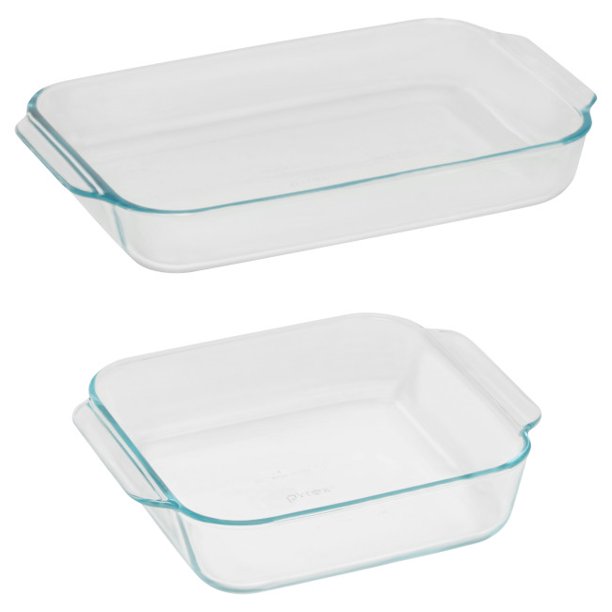
Many of us own Pyrex glassware. The company was established in 1915 and originally made its glassware products with borosilicate glass. In recent years, corporate changes took place and newer products have since been made with tempered soda-lime glass. As a consumer, you can easily determine which type of glass your glassware is made from by looking at the brand name. If it is spelled in all capital letters (PYREX), it was made with borosilicate glass. If it is spelled in all small letters (pyrex), it was made with tempered soda-lime glass. Any newer borosilicate PYREX glassware is currently being made in Europe.

Anchor Hocking Glassware
This brand of glass bakeware is made of tempered soda-lime glass.

Libby Glassware
Libby glass bakeware is made of tempered soda-lime glass.

1790 Brand Glassware
This brand of glassware is made of borosilicate glass.

Amazon Basics Glass Bakeware
This brand of glassware is made of borosilicate glass.

OXO Glass Bakeware
This brand of glassware is made of borosilicate glass.

How to Minimize the Risk of Breakage
Glass bakeware comes with instructions for use and care. We should all read the paperwork that comes with such things, and follow the instructions carefully. But many times, the paperwork gets tossed aside and never read. So, here are some general tips for the safe use of glass bakeware.

* Avoid extreme changes in temperature, such as taking glassware directly from the freezer to a hot oven, or from a hot oven to the sink. Care should also be used when placing a frozen glassware item into the microwave.

* Do not add liquid to hot glassware. Allow it to cool down first.

* Do not place hot glass bakeware on cold or wet surfaces, countertops, or stovetops. Instead, place them on a dry towel or hot pads, wooden cutting board, cooling rack, or trivets designed for hot glass items.

* Do not put hot glassware into the refrigerator or freezer. Allow it to cool down first.

* Do not use glassware on the stovetop, under a broiler, or in a toaster oven.

* Do not heat empty glassware.

* Always preheat the oven first before placing glassware (WITH FOOD IN IT) in the oven.

* Don’t use glassware to microwave popcorn or heat food that is in browning wrappers.

* When heating cheese, oil, or butter in glassware in the microwave, don’t overheat it. Heat it only for the minimum time needed.

* Allow glass bakeware to cool completely before immersing it in water.

* Use care not to bump, poke, or scratch glass bakeware with utensils of any type.

* Do not use glass bakeware that has any chips, cracks or other damage, which can cause them to suddenly shatter.

* Do not microwave nearly empty glassware. Be sure it has ample food in it to absorb the heat generated by the radiation from the microwave.


Resources

https://www.nytimes.com/wirecutter/blog/tempered-vs-borosilicate-glass/

https://www.thespruceeats.com/best-glass-storage-containers-4154183

https://healthy-cookware.com/why-glass-food-storage-containers-are-better-than-plastic/

https://icedteapitcher.myshopify.com/blogs/news/how-can-you-tell-if-pyrex-is-borosilicate

https://www.westlab.com/blog/2017/11/02/what-is-the-difference-between-soda-lime-glass-and-borosilicate-glass

https://www.dillmeierglass.com/news/what-is-annealed-glass

https://www.bullseyeglass.com/what-is-annealing-why-is-it-necessary.html

https://www.m3glass.com/blog/tempered-vs-annealed/

https://www.materialshub.com/material/soda-lime-glass/

https://www.lenntech.com/glass.htm

https://www.onedayglass.com/annealed-vs-tempered-glass-difference/

https://gizmodo.com/the-pyrex-glass-controversy-that-just-wont-die-1833040962

https://www.dontwasteyourmoney.com/best-glass-bakeware-set/

https://pittsburgh.cbslocal.com/2011/09/06/consumer-reports-tests-glass-bakeware/

https://www.thespruceeats.com/glass-bakeware-safety-tips-1907162

https://www.amazon.com/Piece-Glass-Food-Storage-Container/dp/B01IU416YG

https://www.walmart.com/ip/1790-Glass-Food-Storage-Containers-with-Lids-Glass-Meal-Prep-Containers-Airtight-Glass-Lunch-Boxes-BPA-Free-FDA-Approved-Leak-Proof/921652275

https://www.amazon.com/dp/B076HZFG41?th=1

https://www.amazon.com/AmazonBasics-Oblong-Baking-Dishes-BPA-Free/dp/B08BS692GS/ref=sr_1_1_sspa?dchild=1&keywords=glass+bakeware&qid=1622758294&sr=8-1-spons&psc=1&spLa=ZW5jcnlwdGVkUXVhbGlmaWVyPUEyUUFTQ0VYREtRWElaJmVuY3J5cHRlZElkPUEwNDAyODEyMVpWTFpYQVg4Ujk0NSZlbmNyeXB0ZWRBZElkPUEwMjQ1MTM0SDVNUUdPUjVXNlo3JndpZGdldE5hbWU9c3BfYXRmJmFjdGlvbj1jbGlja1JlZGlyZWN0JmRvTm90TG9nQ2xpY2s9dHJ1ZQ==

https://www.amazon.com/OXO-Grips-Freezer-Oven-Baking/dp/B019FHD0FK/ref=sr_1_12?dchild=1&keywords=glass+bakeware&qid=1622758418&sr=8-12

https://worldofpans.com/can-you-put-pyrex-in-oven/

https://cooking.stackexchange.com/questions/68317/why-must-the-oven-be-preheated-for-a-pyrex-glass-pan

https://12tomatoes.com/limitations-pyrex-cookware/

https://www.tasteofhome.com/article/pyrex-dish/


Apples

Apples 101 – About Fuji Apples


Apples 101 – About Fuji Apples

Origin
Fuji apples originated in Fujisaki, Japan in the late 1930s. Growers at the Tohoku Research Station cross pollinated Red Delicious and Virginia Ralls Janet apples to create the Fuji. Since the apple was introduced in the United States in the 1980s, its popularity has grown to becoming one of the most sold varieties of apples. Today, the United States grows more Fuji apples than Japan. Their popularity has grown to becoming the most commonly grown apple around the world.

Nutrition and Health Benefits
Fuji apples are an excellent source of Vitamin C. They are also a good source of fiber along with some Vitamin A, iron, potassium, folate, magnesium, manganese, calcium, riboflavin, Vitamin B6, Vitamin B1, and pantothenic acid. One medium Fuji apple has about 100 calories.

Vitamin C is a critical antioxidant in the body and benefits health in a number of ways. Not only does it help to boost the immune system and support skin and membrane health, but Vitamin C also plays a role in preventing diabetes, cancer, and other medical conditions such as gout, high blood pressure, and iron deficiency.

One Fuji apple supplies between 4 and 5 grams of fiber, most of which is in the skin. Adequate fiber in the diet not only keeps the contents of the intestines moving forward, but it helps to lower blood cholesterol and reduce the risk of developing heart disease, cancer, and diabetes.

The peel of Fuji apples not only contains fiber, but also quercetin, a flavonoid that has been found to reduce the risk of heart attack by about 32 percent. In fact, Fuji apples have been found to have the highest overall concentration of bioflavonoids of any variety of apple. Quercetin and other bioflavonoids help protect us from serious diseases such as heart disease and cancer. They also help to maintain our overall health including controlling weight. Researchers have found that regular consumption of apples, like Fuji apples, may reduce our risk of lung cancer significantly, by up to 50 percent.

Characteristics of Fuji Apples
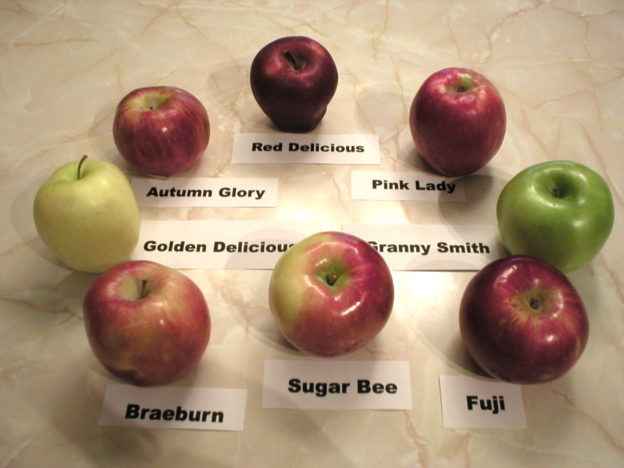
Appearance. Fuji apples are moderate in size and are somewhat round with a slight lopsided appearance. They have a semi-thick skin that is smooth, waxy, and has a yellow-green base covered in red-pink striping and blush. The skin colorations may vary depending on cultivation techniques. The flesh is dense, juicy, crispy, fine-grained and pale ivory to white in color.

Flavor and Texture. Fuji apples are dense, juicy, and crisp, with creamy white flesh. The apples are well-known for their exceptional sweetness, low acidity, juiciness, firmness, and crispiness. Their blend of sweetness and acid gives them the perfect balance of a sweet-tart flavor. Some people consider them to be the sweetest of all apple varieties. They have a Brix (sugar) level of 15 to 18, making them to be among the sweetest of apples.

Storage/Shelf-Life.  Fuji apples have a long storage life, making them available year-round. When kept in a cool, dry, and dark place, such as a refrigerator, Fuji apples can keep for 3 months. Fuji apples are one of the best apples for freezing.

Best Uses for Fuji Apples
Fresh. Fuji apples are wonderful when eaten fresh. They are refreshing and satisfying. They can be sliced and tossed into green and fruit salads, grated into coleslaw, or chopped and used as a topping over oatmeal, pancakes, and cereal. They can be sliced thin and added to sandwiches. They may even be placed on a stick and dipped in caramel or candy coatings for a sweet treat at food festivals. Fuji apples pair well with assorted cheeses such as cheddar, goat, brie, Gorgonzola, and blue cheeses. Fuji apples can also be pressed into juices, and made into apple cider and wine.

Baking. Fuji apples are excellent when baked into pies, cakes, tarts, quiches, crumbles, crisps, and muffins. They can even be used as a pizza topping. They hold their shape well when baked, so they would be an excellent choice for baked apples.

Cooking. The thick skin and dense flesh of Fuji apples allows them to hold up well when cooked, making them a popular variety to be used in soups and roasts. Fuji apples pair well with meats such as pork chops, bacon, sausage, turkey and poultry. They can also be mashed into potatoes. They pair well with vegetables such as spinach, cabbage, Brussels sprouts, and green beans. Fuji apples can even be chopped and added to rice dishes for a touch of sweetness.

Drying. Fuji apples hold up well when dehydrated. As with any other apple, they should be first treated with an acid solution (such as lemon water) to prevent them from turning brown during the process.

Recipe Links
Ultimate Apple Crisp https://dinnerthendessert.com/classic-apple-crisp-double-the-crisp/

Fuji Applesauce https://www.simplyrecipes.com/recipes/applesauce/

Japanese Apple Salad https://www.justonecookbook.com/apple-salad/#wprm-recipe-container-60329

Apple Cinnamon Oatmeal Stovetop Recipe https://www.sugardishme.com/apple-cinnamon-stovetop-oatmeal/

Waldorf Salad https://appleforthat.stemilt.com/recipes/waldorf-salad/

Easy Apple Crisp https://www.bowlofdelicious.com/apple-crisp/#recipe

Slow Cooker Baked Apple Dessert https://www.yummly.com/recipe/Slow-Cooker-Baked-Apple-Dessert-1216726

Maple Pecan Apple Crisp https://www.yummly.com/recipe/Maple-Pecan-Apple-Crisp-1914147

Apple Almond Galette https://www.yummly.com/recipe/Apple-Almond-Galette-1793662

Hungry Girl’s Slow Cooker Apple and Oat Goodness https://www.yummly.com/recipe/Hungry-Girl_s-Slow-Cooker-Apple-_-Oat-Goodness-2061874

Easy Oven Baked Fuji Apple Chips https://www.onsuttonplace.com/oven-baked-fuji-apple-chips/

Baked Fuji Apple Slices https://healthyrecipesblogs.com/baked-apple-slices-recipe/#recipe

Healthy Baked Apples https://thecleaneatingcouple.com/healthy-baked-apples/#recipe

Dehydrated Cinnamon Apples Recipe https://recipesworthrepeating.com/dehydrating-apples-cinnamon-apples-recipe/

Resources
https://www.stemilt.com/fruits/apples/fuji-apples/

https://www.specialtyproduce.com/produce/Fuji_Apples_914.php

https://bestapples.com/varieties-information/varieties/#

http://www.milesfarmersmarket.com/wp-content/uploads/Produce-Apple-Chart-Uses.pdf

https://www.openfit.com/a-guide-to-the-most-popular-apple-varieties

https://www.tasteatlas.com/most-popular-apples-in-the-world

https://www.taste.com.au/quick-easy/articles/ten-secrets-of-fuji-apples/50penv88

https://recipesworthrepeating.com/dehydrating-apples-cinnamon-apples-recipe/#ingredients-youll-need

https://appleforthat.stemilt.com/theres-an-apple-for/dehydrating/

https://www.calorieking.com/us/en/foods/f/calories-in-fresh-fruits-fuji-apple-raw-with-skin/IcwdMroNR4KyOnCR3pi24Q

https://tools.myfooddata.com/nutrition-facts/167793/wt3

https://www.livestrong.com/article/375943-fuji-apple-health-benefits/

https://www.webmd.com/vitamins/ai/ingredientmono-294/quercetin

https://www.healthline.com/nutrition/vitamin-c-benefits#5.-Helps-prevent-iron-deficiency


About Judi

Julia W. Klee (Judi) began her journey enjoying “all things food” in elementary school when she started preparing meals for her family. That love of food blossomed into a quest to learn more and more about health and wellness as related to nutrition. She went on to earn a BS Degree in Food and Nutrition, then an MS Degree in Nutrition. She has taught nutrition and related courses at the college level to pre-nursing and exercise science students. Her hunger to learn didn’t stop upon graduation from college. She continues to research on a regular basis about nutrition as it relates to health. Her hope is to help as many people as possible to enjoy foods that promote health and wellness.

Rutabagas

Rutabagas 101 – The Basics (UPDATE)


Rutabagas 101 – The Basics (UPDATE)

About Rutabagas
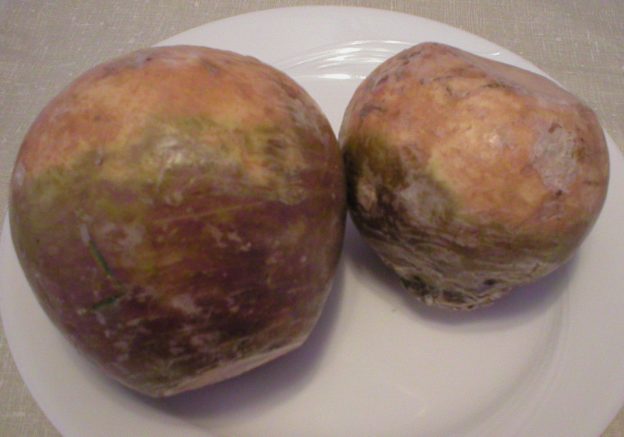
Rutabagas are root vegetables that are members of the cruciferous family. They are called rutabagas mostly in North America. Elsewhere around the world they are known as swedes. They may also be called yellow turnips or neeps.

Their origin remains a mystery, but many people believe they are native to Scandinavia and Russia, and are believed to be a cross between a turnip and a cabbage. Their skin is yellowish at the root end, and purple toward the stem end. They look very much like turnips with pale yellow flesh. The flavor of rutabaga is peppery and slightly bitter when raw, but it becomes creamy and sweet when roasted.

Not only is the root of the plant edible, but the leafy greens are also used as food in various cultures. The leaves are eaten like many other leafy greens, such as collards and kale. The root (rutabaga) can be eaten raw or prepared in a number of ways, including like potatoes, being roasted or cooked and mashed. It may also be used as a filler in casseroles and even mincemeat.

Nutrition and Health Benefits
Rutabagas are high in many nutrients which gives them a number of associated potential health benefits. They are exceptionally high in Vitamin C, with 1 cup of cooked rutabaga providing over 1/3 of the daily recommended intake of this important vitamin. They also contain a lot of Vitamin B1, fiber, folate, Vitamin B6, choline, niacin, potassium, phosphorus, magnesium, copper, pantothenic acid, Vitamin B2, Vitamin E, manganese, omega-3 fatty acids, and even some calcium, iron and zinc.

Anti-Cancer Properties. Like other cruciferous vegetables, rutabagas are high in glucosinolates, sulfur-containing antioxidant compounds that are broken down during digestion into other health-promoting phytonutrients. These compounds include a variety of isothiocyanates that have strong antioxidant and anti-inflammatory effects that can help to boost the immune system and reduce the risk of heart disease and various types of cancer.

Boosts Immunity. The high level of Vitamin C found in rutabagas makes them a valuable food to include in the diet. Vitamin C is an important antioxidant that is known for disarming free radicals, which are harmful molecules that damage healthy cells causing oxidative stress and leading to disease. Vitamin C also stimulates the production of white blood cells. These cells are valuable in protecting us from invading pathogens such as viruses and bacteria, thereby preventing illness.

In addition to boosting immunity, Vitamin C is also used in the production of collagen, which is important in the repair and maintenance of skin tissue, muscles, and blood vessels.

Rutabagas also contain a good supply of Vitamin E, a fat-soluble antioxidant. Like Vitamin C, Vitamin E also fights cell damage, helping to maintain healthy cell membranes. Vitamins C and E work closely together, with Vitamin C helping to regenerate Vitamin E when it is depleted. This helps to provide continual protection for our cells.

Bowel Health. Rutabagas are an excellent source of fiber, with one medium rutabaga providing around one-fourth of the suggested daily fiber intake for adults. They are high in insoluble fiber, which provides bulk to the stool and promotes healthy bowel function. This not only prevents constipation, but also lowers the risk of colorectal cancer and other bowel diseases, heart disease, and Type 2 diabetes.

Cardiovascular Protection. Rutabagas also supply a lot of potassium, with one medium rutabaga providing about one-third of our daily needs. Potassium helps to lower blood pressure by relaxing vessels. The potassium, along with the fiber in rutabagas, work together to help reduce the risk of atherosclerosis, heart attacks, and strokes.

Supports Bone Health. The vast array of minerals found in rutabagas work together to help keep bones healthy and strong. This reduces the risk of osteoporosis, a common age-related disorder plagued by many senior adults.

How to Select a Rutabaga
Look for rutabagas that are smaller rather than larger, since the smaller ones will be more tender. Choose ones that are 5-inches or less in diameter to avoid those that are tough and fibrous. Avoid ones with punctures, cracks, bruises, soft spots, or wrinkles. Most of the time, the roots will be covered with a protective wax coating which helps to extend their shelf life. However, you might find them unwaxed when they are in season, from late fall through winter.

How to Store Rutabagas
Store rutabagas in a plastic bag in the refrigerator, or in a cold cellar. They may keep for up to a month or longer, depending upon how fresh they were when purchased. If the leaves are still attached, they should be removed before storing the root to prevent it from drying out. Wrap the leaves in a slightly damp paper towel or cotton cloth, then place that loosely in a plastic bag and store them in the refrigerator. Use the leaves as soon as possible.

How to Prepare Rutabagas
Rutabagas should be washed, then peeled with a sturdy vegetable peeler or a paring knife. When using a knife, it can be helpful to first trim a slice off the bottom so it can rest steadily when being trimmed. Once the rutabaga has been peeled, it can be cut into any shape needed, such as quartered, sliced, diced, shredded, or julienned.

How to Freeze Rutabagas
First peel, then cut your rutabagas into cubes. Bring a pot of water to boil. Place the cubes in the boiling water and immediately set the timer for 3 minutes. When the timer is finished, immediately transfer the cubes to a bowl of cold water. Allow them to cool for 3 minutes. Then drain the water and transfer the cubes to freezer containers or bags. Label them with the current date and use them within 6 months.

If preferred, to prevent the rutabaga cubes from freezing into a big lump, the blanched cubes may be frozen first before being placed in the freezer container or bags. Spread the blanched, cooled, and drained cubes out in a single layer on a parchment paper-lined tray. Place that in the freezer. Once they are frozen, transfer them to freezer containers or bags, as detailed above.

Quick Ideas and Tips for Using Rutabagas
* Try adding shredded rutabaga to your favorite coleslaw.

* Try baked rutabaga fries.

* Rutabagas need high humidity (but not a wet environment) and cold temperatures when being stored. Since the refrigerator is a very dry environment, they will keep best in plastic bags when being stored in the refrigerator.

* Try a hearty stew with carrots, potatoes, rutabagas, turnips, and other root vegetables.

* Try adding diced rutabaga to your favorite soups, stews, and casseroles.

* Try making hash browns with rutabagas instead of potatoes.

* Try adding a little grated raw rutabaga to a green salad.

* Try sautéed rutabagas with apples and a little honey.

* Try sautéing spiralized rutabaga noodles, seasoned with a little olive oil and salt.

* For a hint of the flavor of a rutabaga, smell it. The more pronounced the aroma, the more pungent the flavor.

* One medium rutabaga is about 1-1/2 to 2 pounds and will yield 4 to 5 cups when cubed.

* Although the flavors will be somewhat different and change the flavor profile of your dish to some degree, the following foods can be substituted for rutabaga in many recipes: turnips, broccoli stems, or kohlrabi bulbs. You could also substitute rutabagas with parsnips, beets, potatoes, sweet potatoes, or carrots.

Herbs and Spices That Go Well with Rutabagas
Allspice, basil, bay leaf, caraway seeds, cardamom, cayenne, cinnamon, coriander, cumin, dill, fennel seeds, mace, marjoram, mint, mustard, nutmeg, oregano, paprika, parsley, pepper, rosemary, saffron, sage, salt, savory, star anise, tarragon, thyme, vanilla

Foods That Go Well with Rutabagas
Proteins, Legumes, Nuts, Seeds: Almonds, beef, chestnuts, chicken, eggs, ham, hazelnuts, lamb, lentils, nuts (in general), peanuts, pistachios, pork, poultry, sausage, tofu, turkey

Vegetables: Artichokes, beets, bok choy, broccoli, carrots, celery, celery root, chives, fennel, garlic, ginger, greens (bitter, i.e., collard, dandelion), horseradish, kale, leeks, mushrooms, onions, parsnips, potatoes (esp. mashed), root vegetables (in general), scallions, squash (winter), sweet potatoes, tomatoes, turnips, watercress

Fruits: Apples (fresh, cider, juice), lemon, lime, orange, pears, raisins

Grains and Grain Products: Barley, farro, quinoa

Dairy and Non-Dairy: Butter, cheese (esp. blue, cream, goat, Gruyère, Parmesan), coconut milk, cream, milk (dairy and non-dairy), sour cream

Other Foods: Agave nectar, honey, maple syrup, miso, molasses, mustard (prepared), oil (esp. hazelnut, nut, olive, sunflower), stock, sugar (esp. brown), vinegar (esp. balsamic, cider, malt, sherry)

Rutabagas have been used in the following cuisines and dishes…
Baked goods (i.e., pies, tarts), casseroles, egg dishes (i.e., frittatas), hash (i.e., served with eggs),  purees, salads, Scottish cuisine, soups, stews, stir-fries, Swedish cuisine

Suggested Food and Flavor Combos Using Rutabagas
Add rutabagas to any of the following combinations…

Apples + Carrots + Onions + Sweet Potatoes
Apples + Maple Syrup
Broccoli + Carrots
Caraway Seeds + Garlic
Carrots + Egg (fried) + Parsnips + Potatoes
Carrots + Mustard + Parsley + Potatoes
Carrots + Nutmeg + Potatoes
Cheese + Potatoes
Celery + Onions
Coconut Milk + Lime
Leeks + Turnips
Parsnips + Potatoes
Potatoes + Rosemary + Thyme

Recipe Links
Pan Roasted Rutabaga https://food52.com/recipes/14559-pan-rosted-rutabaga

Mashed Rutabaga with Sour Cream and Dill https://www.simplyrecipes.com/recipes/mashed_rutabaga_with_sour_cream_and_dill/

7 Dinner Recipes That Will Have Your Tastebuds Rooting for Rutabaga https://www.cheatsheet.com/life/7-dinner-recipes-that-will-have-your-tastebuds-rooting-for-rutabaga.html/

Mashed Potatoes with Rutabagas and Buttermilk https://www.epicurious.com/recipes/food/views/mashed-potatoes-with-rutabagas-and-buttermilk-15635

Carrots and Rutabagas with Lemon and Honey https://www.epicurious.com/recipes/food/views/carrots-and-rutabagas-with-lemon-and-honey-105812

Roasted Root Vegetables with Rosemary https://www.epicurious.com/recipes/food/views/roasted-root-vegetables-with-rosemary-106009

9 Surprisingly Simple Ways to Eat Rutabaga https://www.goodhousekeeping.com/health/diet-nutrition/a20706455/rutabaga-recipes/

Rutabaga Chipotle Soup https://www.thekitchn.com/recipe-rutabaga-chipotle-soup-100959

Cider-Braised Corned Beef with Rutabaga https://www.foodnetwork.com/recipes/food-network-kitchen/cider-braised-corned-beef-with-rutabaga-3364547

Creamy Rutabaga, Parsnip, and Cheddar Soup https://themom100.com/recipe/creamy-rutabaga-parsnip-and-cheddar-soup/

Curried Vegetarian Shepherd’s Pie https://www.foodnetwork.com/recipes/curried-vegetarian-shepherds-pie-3364924

Roasted Rutabaga Hummus https://simplebites.net/roasted-turnip-hummus-recipe/

Glazed Root Vegetables https://www.bonappetit.com/recipe/glazed-root-vegetables

Roasted Root Vegetables with Tomatoes and Kale https://www.simplyrecipes.com/recipes/roasted_root_vegetables_with_tomatoes_and_kale/?epik=dj0yJnU9amZ3LUxJYVZmSklZQTR5UHItODA5NkN3UXc3YnlmTXImcD0wJm49YnBxMHhiMDJQRFhSNElYeW1rdTZKUSZ0PUFBQUFBR0FXX3pV#recipe13840


Resources
https://producemadesimple.ca/goes-well-rutabaga/

https://www.thekitchn.com/rutabaga-recipes-tips-and-ideas-22928359

https://tools.myfooddata.com/nutrition-comparison/168455-168454/wt1-wt1/1-1

https://www.organicfacts.net/health-benefits/vegetable/rutabaga.html

https://lpi.oregonstate.edu/mic/food-beverages/cruciferous-vegetables

https://www.urmc.rochester.edu/encyclopedia/content.aspx?ContentID=35&ContentTypeID=160

https://wearechefs.com/featured-ingredient-rutabaga/

https://www.healthline.com/nutrition/rutabagas

https://www.canr.msu.edu/uploads/resources/pdfs/Rutabagas_(HNI52).pdf

https://www.diynetwork.com/how-to/outdoors/gardening/how-to-store-rutabaga

https://yrmchealthconnect.org/ode-to-rutabagas-2/

https://harvesttotable.com/rutabaga_rutabaga_is_tasty_ser/

https://www.thespruceeats.com/how-to-freeze-rutabaga-2-ways-3061920

Cooperative Extension Service, The University of Georgia. (1993) So Easy to Preserve. Bulletin 989. 3rd Edition. Athens, Georgia: Cooperative Extension Service, The University of Georgia.

Joachim, David. (2010) The Food Substitutions Bible. 2nd Edition. Toronto, Ontario, Canada: Robert Rose, Inc.

Page, Karen. (2014) The Vegetarian Flavor Bible. New York, NY: Little, Brown and Company.


About Judi

Julia W. Klee (Judi) began her journey enjoying “all things food” in elementary school when she started preparing meals for her family. That love of food blossomed into a quest to learn more and more about health and wellness as related to nutrition. She went on to earn a BS Degree in Food and Nutrition, then an MS Degree in Nutrition. She has taught nutrition and related courses at the college level to pre-nursing and exercise science students. Her hunger to learn didn’t stop upon graduation from college. She continues to research on a regular basis about nutrition as it relates to health. Her hope is to help as many people as possible to enjoy foods that promote health and wellness.
Envy Apples

Apples 101 – About Envy Apples


Apples 101 – About Envy Apples

Origin
Envy apples were developed in New Zealand by natural plant breeding methods (with no genetic modification) used to produce a fruit with desirable traits. Developers focused on appearance, flavor, and longevity. They are a cross between Braeburn and Royal Gala apples. Envy apples were first released for sale in 2009 with a projected production of 2 million cartons by 2020.

Envy apples are grown using a method introduced in New Zealand in 1996, where environmental concerns are taken into account. Only pesticides and fungicides based on the need at the time are applied to the tree, and nothing more. Most of New Zealand’s apples are grown using this method. If you’re concerned about chemicals on your apples, know that apples grown in this way have no more chemicals on them than what was needed to produce a quality product.

Currently Envy apples are grown in New Zealand, Australia, Chile, and the United States in the state of Washington. Field tests are being done in the UK, France, and Italy in hopes of expanding production. They are available almost year-round from sources in New Zealand, Chile, and the United States.

Envy apples are sweet and slow to oxidize or turn brown, which makes them excellent apples for eating fresh. Because of their parentage, Envy apples are considered to be similar to Gala, Braeburn, Jazz, Pacific Rose, and Telstar apples.

Nutrition Facts
The nutritional aspects of Envy apples would be roughly equivalent to that of other sweet apples. One apple has about 95 calories. They are high in Vitamin C and fiber. They also supply potassium, Vitamin B6, Vitamin K, manganese, riboflavin, copper, phosphorus, magnesium, thiamin, Vitamin A and Vitamin E. It is worth noting that a lot of the nutrients found in apples are in the skin. So, eat the peel, if possible.

Envy apples also contain quercetin, a flavonoid that gives apples their color. Quercetin is also an antioxidant known to combat free radical damage and inflammation that is linked to cancer, heart disease, degenerative brain disorders, and other chronic diseases.

Characteristics of Envy Apples
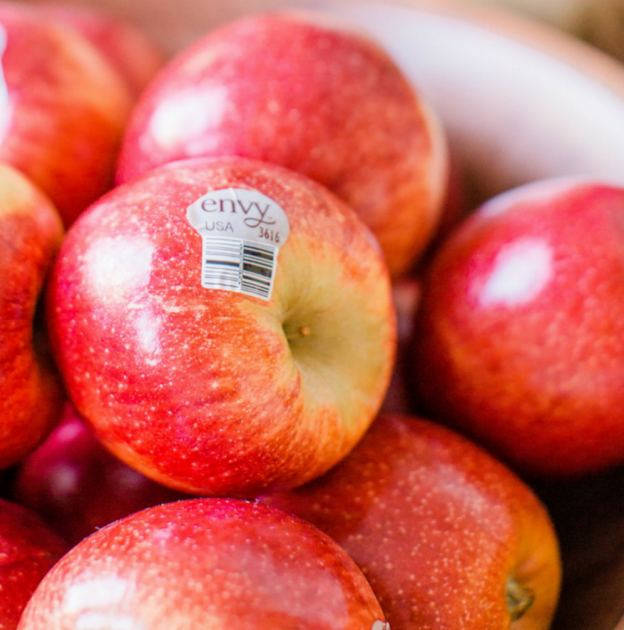
Appearance. Envy apples are round with red skin that has some yellow to green striations or streaks, with specks throughout the skin. The flesh is pale yellow and is very slow to oxidize, taking up to 10 hours to begin to turn brown. This quality makes Envy apples an excellent choice for eating fresh in salads or served on appetizer trays.

Flavor and Texture. The pale-yellow flesh is crisp and sweet with a hint of tartness. The flavor has been described like that of a gourmet Asian pear, with floral and vanilla notes. The skin is thick and tougher than other apples. Also, the skin has what are known as lenticels, or small pores, that allow gases to exchange between the skin and flesh of the fruit. The lenticels appear as specks on the skin of the fruit. The more specks, the sweeter the fruit. So, if you want a sweet apple, select an Envy apple with a lot of specks on the skin!

In 2019, Envy apples were compared with other apples including Honeycrisp, Fuji, Gala, and Cosmic Crisp apples in a research study conducted in New York with 142 participants. Envy apples were ranked in first place for their flavor, texture, aroma, and appearance.

Storage/Shelf-Life.  When kept refrigerated, Envy apples should have a long storage life. How long will depend on the apple’s age when it was purchased. Apples store best in very cold and somewhat humid environments, with a temperature range from 30 to 40°F (the colder, the better). The refrigerator can meet the temperature need, so keeping them in the refrigerator crisper drawer with the air vent open should give them the longest life span possible. To help increase humidity (which helps to keep apples crisp), you could place a damp paper towel in the drawer with the apples. However, always keep the drawer air vent open to prevent the ethylene gas from building up around the apples, which would cause them to age faster.

Best Uses for Envy Apples
Fresh. Envy apples are excellent for any application where fresh apples would be used. Since they are very slow to oxidize, they will stay fresh looking when cut early for salads or appetizer trays. Envy apples are an excellent choice for classic Waldorf and other salads. Envy apples also pair well with cheese and fruity oatmeal bowls.

Baking. Envy apples are excellent when used in baked applications. Whether they are prepared as baked apples or included in pies, crisps, or other baked goods, the characteristics of their parents come through with the sweetness of Gala apples, and the texture of Braeburns. They can be used on their own or combined with other apples as desired. The flavor of Envy apples makes then an exceptional apple for cakes and pies.

Cooking. Envy apples can be cooked into sauce. They hold their shape and flavor well when cooked in any application. Envy apples pair well with chicken and pork in savory dishes, and also chicken salads. Bear in mind that the skin of Envy apples can be rather tough, so it won’t break down easily when cooked. It may be best to remove the skin when these apples used in any cooked dish.

Drying. Envy apples are good candidates for being dehydrated. Even though they are slow to brown, it would still be best to treat them with an acid solution (such as lemon water) before drying to help preserve their color.

Recipe Links
Envy Apple Oat Crumble and Citrus Caramel Topping https://envyapple.com/en/enjoying-envy/envytm-apple-oat-crumble-citrus-caramel-topping

Grilled Chicken and Envy Apple BBQ Sauce https://envyapple.com/en/enjoying-envy/grilled-chicken-envytm-apple-bbq-sauce

Savory French Toast with Envy Apple Salsa https://envyapple.com/en/enjoying-envy/savory-french-toast-envytm-apple-salsa

Envy Avocado Toast https://envyapple.com/en/enjoying-envy/envytm-avocado-toast

Roasted Peaches with Envy Apples with Warm Hazelnut Vinaigrette https://envyapple.com/en/enjoying-envy/roasted-peaches-envytm-apples-warm-hazelnut-vinaigrette

Roasted Root Vegetables and Envy Apples with Pecan Crumble https://envyapple.com/en/enjoying-envy/roasted-root-vegetables-envytm-apples-pecan-crumble

Envy Apple and Strawberry Swirl Sorbet https://envyapple.com/en/enjoying-envy/envytm-apple-strawberry-swirl-sorbet

Shaved Fennel and Envy Apple Salad https://envyapple.com/en/enjoying-envy/shaved-fennel-and-envytm-apple-salad

Envy Tropical Smoothie https://envyapple.com/en/enjoying-envy/envytm-tropical-smoothie

Envy Apple Pumpkin Pie https://envyapple.com/en/enjoying-envy/envytm-apple-pumpkin-pie

Spiralized Envy Apple and Kale Salad https://envyapple.com/en/enjoying-envy/spiralized-envytm-apple-kale-salad

Elegant Envy Slaw https://envyapple.com/en/enjoying-envy/elegant-envytm-slaw

Best Apple Muffins https://minnetonkaorchards.com/best-apple-muffins/


Resources

https://minnetonkaorchards.com/all-about-envy-apples/

https://specialtyproduce.com/produce/envy_apples_9142.php

https://www.homefortheharvest.com/envy-apples/

https://envyapple.com/en/

https://www.tasteatlas.com/most-popular-apples-in-new-zealand

https://theproducenews.com/shoppers-choose-envy-apples-best-flavor-crunch-and-appearance

https://www.orangepippin.com/varieties/apples/envy-scilate

http://www.produceoasis.com/ProductDetailPage/TabId/272/PId/16/Apples/Envy-Apple.aspx

https://www.healthline.com/nutrition/quercetin#what-it-is

https://www.mountsinai.org/health-library/supplement/quercetin

https://www.thekitchn.com/what-to-store-in-your-refrigerator-humidity-drawers-tips-from-the-kitchn-178094

https://www.mentalfloss.com/article/556777/simple-trick-keeping-your-apples-fresh-longer


About Judi

Julia W. Klee (Judi) began her journey enjoying “all things food” in elementary school when she started preparing meals for her family. That love of food blossomed into a quest to learn more and more about health and wellness as related to nutrition. She went on to earn a BS Degree in Food and Nutrition, then an MS Degree in Nutrition. She has taught nutrition and related courses at the college level to pre-nursing and exercise science students. Her hunger to learn didn’t stop upon graduation from college. She continues to research on a regular basis about nutrition as it relates to health. Her hope is to help as many people as possible to enjoy foods that promote health and wellness.
Blackberries

Blackberries 101 – The Basics


Blackberries 101 – The Basics

About Blackberries
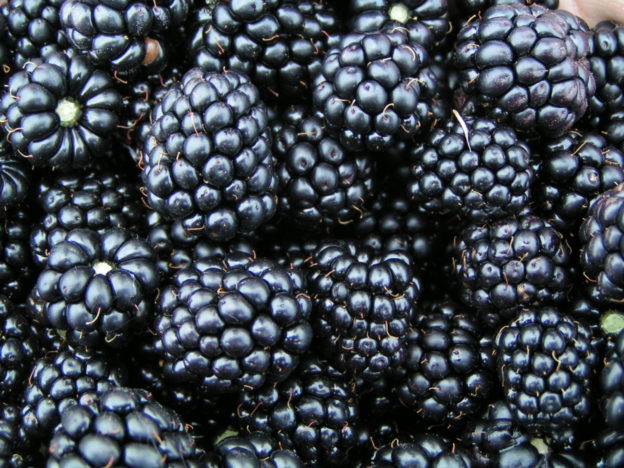
Blackberries are large, deep purple berries that often grow wild on thorny bushes. The plants are members of the Rubus (rose or Rosaceae) family. They are closely related to raspberries, which are in the same plant genus, Rubus. Blackberries are native to northern temperate areas, especially in eastern North America, and on the Pacific coast of North America.

There are 375 species of blackberry plants, found around the world. Today there are thousands of blackberry hybrid varieties, including thornless bushes, which were developed in recent years. The first modern blackberry variety was developed in 1880 by Judge Logan of California. His plant was released as the Loganberry. Blackberries are sometimes referred to as brambleberries. However, the term “brambleberry” can also be used to refer to other thorny bushes that produce fruits, such as raspberries, boysenberries, loganberries, and others.

Blackberries are sweet/sour, with a juicy texture and lots of crunchy seeds. They can be enjoyed fresh, cooked, and frozen, and are popular in desserts, jams, jellies, candy and sometimes wine. Blackberries are often combined with other fruit, such as apples, for pies and crumbles.

Ancient cultures rarely cultivated blackberry bushes. Instead, they were treated as wild plants and used for medicinal purposes. The ancient Greeks used blackberries as a remedy for gout. The ancient Romans made a medicinal tea from the leaves of the blackberry plant to treat assorted illnesses.

Nutrition and Health Benefits
Blackberries are an excellent source of Vitamins A, B1, B2, B3, B6, C, E, and K, and also folate, calcium, manganese, iron, magnesium, phosphorus, potassium, and zinc. They are a good source of amino acids (protein) and fiber. Blackberries have only 43 calories in 3.5 ounces (100 grams), and 1 cup (about 140 grams) has about 62 calories. They are a low-calorie food, so eat all you want!

Blackberries also have an abundant supply of antioxidants, especially anthocyanins and phenolic compounds, that give blackberries their deep color and offer a variety of health benefits.

Antioxidant Protection, Anti-Cancer and Other Health Effects. Research studies have suggested that berries high in anthocyanins (like blackberries) may protect against cancers of the esophagus, mouth, breast, colon, and possibly other types of cancer. Blackberry extracts have been shown to demonstrate antimutagenic effects by suppressing tumor promoting factors. This in itself helps to lower the risk of developing cancer. Research to this effect is scarce, but warrants further testing.

Blackberries, along with other berries are high in antioxidants that keep harmful free radical molecules under control. Free radicals are unstable molecules that can damage cells when their numbers get too high, causing oxidative stress. Reducing oxidative stress lowers the risk of cardiovascular disease and cancer.

The antioxidants found in blackberries and other berries have been shown to help protect eyes against harmful free radicals and oxidative stress. Rutin, a plant pigment (flavonoid) found in blackberries, has been shown to strengthen blood vessels to the eyes and thereby improve eye health and ward off diseases like macular degeneration and cataracts.

High in Vitamin C. Just one cup of fresh blackberries has about 30 milligrams of Vitamin C. That’s half of the recommended daily intake of this crucial antioxidant vitamin needed for collagen formation in bones, connective tissue and blood vessels. Vitamin C is also used in wound healing, regenerating skin, fighting harmful free radical molecules in the body, iron absorption, fighting disease, and preventing scurvy (the Vitamin C deficiency disease). Vitamin C also is an important antioxidant in the body that helps reduce oxidative stress that can lead to the development of cancer.

Low Glycemic Index and Glycemic Load: Blood Sugar and Insulin Response. Blackberries may improve your blood sugar and insulin levels. They have a low Glycemic Index of only 25. This means they will not cause a big spike in blood sugar when eaten and should be safe for diabetics to eat. This improves blood sugar regulation and may be helpful in keeping cholesterol levels in check.

The Glycemic Load of blackberries is also very low, being only 4. This represents how one’s blood sugar levels may be affected after eating a specific food. With a very low Glycemic Load of only 4, blackberries will hardly, if at all, affect blood sugar levels. Research studies suggest that blackberries may protect cells from high blood sugar levels, help increase insulin sensitivity, and reduce blood sugar and insulin response to high-carbohydrate meals. These effects appeared to happen in both healthy people and those with insulin resistance. This is critical information for diabetics and those managing blood sugar levels, which means that blackberries are fruit such individuals should be able to eat without issue.

High Fiber Benefits. Blackberries are a good source of fiber, including soluble fiber. This type of fiber slows the movement of the intestinal contents, helping to increase the feeling of fullness, reducing hunger. This can help in weight management, reducing the need to eat frequently. Increased fiber also helps to reduce the number of calories absorbed from mixed meals. One research study found that doubling fiber intake could result in eating up to 130 fewer calories in a day.

The high fiber content of berries also means they are low in digestible or net carbohydrates (which is determined by subtracting the total fiber from total carbohydrates). For instance, 3.5 ounces (100 grams) of blackberries has 10.2 grams of total carbohydrates, 5.3 grams of which are fiber. This brings the net carbohydrates of 100 grams of blackberries to 4.9 grams. Because of their low net carbohydrate content, blackberries are considered to be a low-carb-friendly food.

Anti-Inflammatory Benefits. Because of their many antioxidants, berries (including blackberries) have been shown to have strong anti-inflammatory properties. Inflammation is a natural part of the body’s defense mechanism in fighting infection and injury. However, current lifestyles often contribute to excessive, long-term inflammation brought on by increased stress, inactivity, and unhealthy foods. This type of chronic inflammation contributes to diabetes, heart disease, and obesity. Research has shown that the antioxidants in berries may help to lower inflammatory markers, thus reducing the risk of diseases brought on by long-term inflammation.

Skin Health.  Antioxidants in berries help to control free radicals in the body. Free radicals are among the leading causes of skin damage that contribute to aging. Ellagic acid, one of the antioxidants found in blackberries and other berries, appears to be responsible for some of the skin-related benefits attributed to berries. Research suggests that this antioxidant may protect skin by blocking the production of enzymes that break down collagen in sun-damaged skin. Collagen is a protein within the skin’s structure that allows skin to stretch and remain firm. When collagen is damaged, the skin may sag and develop wrinkles.

Brain Health. Blackberries and other berries may improve brain health and prevent memory loss caused by aging. In a review published in the Journal of Agricultural and Food Chemistry, researchers concluded that antioxidants in berries help fight free radicals and alter how brain neurons communicate. This may help reduce inflammation in the brain, which can lead to cognitive and motor issues that often accompany aging.

High in Vitamin K. Blackberries are high in Vitamin K. This vital vitamin plays an important role in the blood clotting function. It is also important in bone metabolism. A deficiency of Vitamin K can lead to bone thinning and fractures, and may cause easy bruising. Just one cup of raw blackberries provides over one-third of the daily recommended value of Vitamin K.

It is noteworthy that if you take blood thinners, monitoring your intake of Vitamin K is important because it can interfere with medications. Eating a consistent amount of Vitamin K-rich foods such as blackberries, green leafy vegetables, soybeans, and fermented dairy foods, helps in the management of medication dosages. Consult with your healthcare provider if you expect to make significant dietary changes that may affect your medication dosages.

High in Manganese. Blackberries are high in manganese. This mineral is vital to healthy bone development, a healthy immune system, metabolizing carbohydrates, amino acids, and cholesterol, and also plays a role in the formation of collagen during wound healing. Manganese may also help prevent osteoporosis, manage blood sugar levels, and reduce epileptic seizures. One cup of fresh blackberries contains almost half the daily recommended value of manganese, so they are clearly a great source of this vital mineral.

How to Select Blackberries
When buying blackberries, choose ones with color ranging from deep purple/black to deep blue/purple. They should not have any green or white patches on them. They should be moderately firm, plump, dry, uniform in color, and not wrinkled or dried out.

When buying blackberries in a grocery store, examine the container for signs of dampness from crushed berries or water droplets that have accumulated, stains and mold. Avoid any containers with any of those indications, which would be signs of age and possible decay. Most blackberries will be packaged with a moisture absorber in the container to help extend the life of the berry (which is desirable). Avoid containers without them, since the berries will age faster.

When picking your own blackberries, choose ones that are plump with a slightly tender feel. They should be dark in color. The skin of a ripe blackberry is dull black and not shiny. [Note that fully ripe blackberries have a short life, so plan to use them right away. Those packaged commercially are picked earlier, when not fully ripe, so they will last longer.] Red to light purple berries are not ripe yet. A ripe blackberry will release from the plant with a slight tug. If a blackberry is dull (not shiny), soft, and starting to leak its juices, it is overripe.

Blackberries start to ripen when the weather is consistently warm. When picking your own blackberries, don’t overfill your container. Limit stacking them to no more than 5 inches high (maximum) to avoid crushing the berries on the bottom. If you pick berries in the heat of the day, the warmth in the picked berries will cause them to age fast. It’s best to spread them out and/or expose them to air conditioning as soon as you can to release the heat and preserve your delicate berries.

How to Store Blackberries
First, remove any damaged or decaying blackberries from the container. Do not wash blackberries until you are ready to use them. Refrigerate unwashed blackberries right away in an open area in the refrigerator. They need to be kept dry. If storing them in a crisper drawer, be sure to have the air vent open, or on the low humidity setting.

For best quality, use your blackberries within 3 days. If they are very fresh, they may keep for up to one week.

How to Prepare Blackberries
Simply wash your berries right before you want to enjoy them. Place them in a colander and rinse them under cold water. Allow them to drain. Or, place them in a bowl of cold water. Gently swish them around, then carefully remove them to a colander to drain.

How to Preserve Blackberries
Extra blackberries can easily be frozen. Simply wash them, drain well to remove as much water as possible. Remove any hulls or stems from the berries and place them in a freezer bag or container. Remove as much air as possible and freeze.

To freeze blackberries so they don’t form one big clump, spread the washed berries out on a baking sheet lined with parchment paper. Place the tray in the freezer. When the berries are frozen, transfer them to a freezer container or bag. Use frozen blackberries within one year.

Quick Ideas and Tips for Using Blackberries
* Combine blackberries with apples in a pie.

* If a recipe calls for blackberries and you don’t have any, loganberries, boysenberries, or raspberries may be used as substitutes.

* One pint of fresh blackberries is about 2 cups.

* Ten ounces of frozen blackberries is about 2 cups.

* Ten blackberries count as one serving.

* Make easy Blackberry-Banana Overnight Oats. Blend 1 cup of blackberries with ½ banana, ½ cup milk of choice, and ½ teaspoon of vanilla extract. Pour into a mason jar. Stir in ½ cup oats. Cover the jar and place it in the refrigerator overnight. In the morning, top with more blackberries and the other half of the banana and enjoy!

* Try a Blackberry-Pomegranate Salad. Make a salad base with red cabbage, lettuce, spinach, blackberries, slivers of pears, and a little red onion. Dress it with a mixture of 2 cups of pomegranate juice, up to ¼ cup honey for a little sweetener, and the juice of ½ lime. Sprinkle the salad with toasted, sliced almonds and enjoy!

* Unripe blackberries will not further ripen after being picked. So, if you’re picking your own, choose only the ripe berries.

* Try easy blackberry popsicles. In a blender, combine ½ cup unsweetened coconut milk, 1/3 cup honey or maple syrup, 2 tsp lemon juice, and 4 cups fresh or frozen blackberries. Blend until smooth, then pour into popsicle molds. Freeze then enjoy! Makes 4 popsicles.

* If you can’t get fresh blackberries locally, opt for frozen. They are usually picked at their peak of ripeness and frozen very quickly after being harvested, sometimes as soon as 20 minutes after being harvested. You can’t get much fresher than that!

* Try toping some pancakes or waffles with fresh blackberries and a little yogurt.

* Top your favorite pudding with fresh blackberries and a sprinkle of granola.

* How about a nut butter and fresh blackberry sandwich? Make it richer by adding sliced banana.

* Try a savory blackberry sauce by gently cooking until smooth: 1 pint of blackberries, ½ cup of balsamic vinegar, and 2 teaspoons of maple syrup or honey. Try it over grilled meat, chicken or seafood. It would work really well with grilled salmon.

* Try an easy frozen treat by blending mashed banana, blackberries, and fruit-flavored yogurt. Pour into muffin cups with a popsicle stick in the middle and freeze.

* Make a parfait by layering yogurt, granola, blackberries and banana slices.

* Add blackberries to a smoothie.

* Use blackberries as a topping for frozen yogurt or ice cream.

* Make a simple fruit salad by combining blackberries, strawberries, blueberries, raspberries, banana slices, and orange segments. Top with a dollop of yogurt and enjoy!

* Add fresh blackberries to your favorite green salad. Dress it with a balsamic vinaigrette and top it off with a sprinkle of slivered almonds or toasted walnuts.

Herbs and Spices That Go Well with Blackberries
Basil, chamomile, cinnamon, lemon herbs (i.e., lemon balm, lemon verbena), mint, nutmeg, pepper, vanilla

Foods That Go Well with Blackberries
Proteins, Legumes, Nuts, Seeds: Almonds, beef, chicken, ham, hazelnuts, pecans, poppy seeds, pork, pumpkin seeds, salmon

Vegetables: Endive, ginger, rhubarb

Fruits: Apples, bananas, blueberries, figs, lemon, lime, mangoes, melons, nectarines, oranges, papaya, peaches, raspberries, strawberries, watermelon

Grains and Grain Products: Granola, oats

Dairy and Non-Dairy: Cheese (i.e., cream, ricotta), cream, crème fraiche, ice cream, mascarpone, milk (in general), sour cream, yogurt

Other Foods: Caramel, chocolate, honey, liqueurs, maple syrup, meringue, rose geranium, sugar, vinegar (balsamic), wine (i.e., fruity, sweet red)

Blackberries have been used in the following cuisines and dishes…
Cereals (breakfast), coulis, desserts (i.e., cobblers, crisps, crumbles, tarts), muesli, pies, puddings, salads (fruit), sauces, smoothies, sorbets, soups (fruit)

Suggested Food and Flavor Combos Using Blackberries
Add blackberries to any of the following combinations…

Apples + Brown Sugar + Cinnamon
Apples + Cinnamon + Hazelnuts
Cinnamon + Orange
Honey + Yogurt
Lime + Mint
Lime + Yogurt
Papaya + Yogurt

Recipe Links
50 Blackberry Recipes to Make Summer So Much Sweeter https://www.countryliving.com/food-drinks/g2450/blackberry-recipes/

Blackberry-Glazed Chicken https://www.countryliving.com/food-drinks/a28610037/blackberry-glazed-chicken-recipe/

Blackberry Freezer Jam https://www.recipegirl.com/blackberry-freezer-jam/

Blackberry Banana Overnight Oats https://www.leahsplate.com/blackberry-banana-overnight-oats/

Blackberry Pie Bars https://thenovicechefblog.com/blackberry-pie-bars/

Blackberry Cobbler in Mason Jars https://spinachtiger.com/blackberry-cobbler-in-mason-jars-and-a-little-bit-of-lifes-thorns/

Blackberry Arugula Salad with Citrus Vinaigrette https://www.gimmesomeoven.com/blackberry-arugula-salad-with-citrus-vinaigrette/#_a5y_p=1149813

Watermelon, Blackberry, and Mint Salad https://www.twopeasandtheirpod.com/watermelon-blackberry-and-mint-salad/

Fall Spiced Skirt Steak Tacos with Blackberry and Pear Slaw https://thenoshery.com/fall-spiced-skirt-steak-tacos-with-blackberry-and-pear-slaw/#_a5y_p=2976145

Sweet Potato Quinoa Cakes with Blackberry Salsa https://www.howsweeteats.com/2012/05/sweet-potato-quinoa-cakes-with-blackberry-salsa/#_a5y_p=1720538

45 Blackberry Recipes Bursting with Juicy Flavor https://www.tasteofhome.com/collection/blackberry-recipes/

Berry-Beet Salad https://www.tasteofhome.com/recipes/berry-beet-salad/

Blackberry Frozen Yogurt https://www.tasteofhome.com/recipes/blackberry-frozen-yogurt/

Avocado Fruit Salad with Tangerine Vinaigrette https://www.tasteofhome.com/recipes/avocado-fruit-salad-with-tangerine-vinaigrette/

Four-Berry Spinach Salad https://www.tasteofhome.com/recipes/four-berry-spinach-salad/

Arugula Salad with Berry Dressing https://www.tasteofhome.com/recipes/arugula-salad-with-berry-dressing/

34 Blackberry Recipes https://www.bonappetit.com/gallery/slideshow/15-blackberry-recipes-convince-king-berries

20 Totally Beautiful Blackberry Desserts https://www.delish.com/cooking/recipe-ideas/g2832/blackberry-recipes/

30 Delicious Blackberry Recipes You Should Try At Least Once https://morningchores.com/blackberry-recipes/

18 Knockout Blackberry Recipes https://www.brit.co/blackberry-recipes/

Spiced Roasted Apples and Blackberries https://www.bbcgoodfood.com/recipes/spiced-roasted-apples-blackberries

Blackberry Strawberry Sorbet [Vegan] https://www.onegreenplanet.org/vegan-recipe/blackberry-strawberry-sorbet/

Resources
http://justfunfacts.com/interesting-facts-about-blackberries/

https://www.healthline.com/health/benefits-of-blackberries#takeaway

https://www.britannica.com/plant/blackberry-fruit

https://www.naturipefarms.com/how-buy-perfect-berries/

https://www.berkeleywellness.com/healthy-eating/food/article/how-choose-best-blackberries

https://www.raspberryblackberry.com/consumers/buying-picking-storing-and-using-your-berries/picking-your-own-blackberries/

https://pickyourown.org/blackberries.htm

https://www.leahsplate.com/blackberry-banana-overnight-oats/#tasty-recipes-7064-jump-target

https://thenoshery.com/fall-spiced-skirt-steak-tacos-with-blackberry-and-pear-slaw/#_a5y_p=2976145

https://cleancuisine.com/blackberry-popsicles/

https://www.bhg.com/recipes/healthy/cooking/heart-boosting-raspberry-and-blackberry-recipes/?slide=slide_77c9e253-2d56-4330-812b-d3083589c93d#slide_77c9e253-2d56-4330-812b-d3083589c93d

https://fruitsandveggies.org/stories/top-10-ways-to-enjoy-blackberries/

https://www.gardeningknowhow.com/edible/fruits/fegen/what-are-brambles.htm

https://www.healthline.com/nutrition/glycemic-index#what-it-is

https://www.health.harvard.edu/diseases-and-conditions/the-lowdown-on-glycemic-index-and-glycemic-load

https://www.bbcgoodfood.com/howto/guide/health-benefits-blackberries

https://www.bbcgoodfood.com/howto/guide/what-are-anthocyanins-and-why-are-purple-foods-so-healthy

https://pubmed.ncbi.nlm.nih.gov/22082199/

https://pubmed.ncbi.nlm.nih.gov/17147415/

https://www.healthline.com/nutrition/11-reasons-to-eat-berries#TOC_TITLE_HDR_2

https://nutritiondata.self.com/foods-009126000000000000000.html?maxCount=34

https://www.carotene.org/top-10-foods-eat-healthy-eyes/

https://www.webrn-maculardegeneration.com/antioxidant-berry.html

https://www.onegreenplanet.org/natural-health/6-amazing-health-benefits-blackberries/

https://ezinearticles.com/?Improving-Your-Vision-Health-With-The-Blackberry-Fruit&id=9720756

Joachim, David. (2010) The Food Substitutions Bible. 2nd Edition. Toronto, Ontario, Canada: Robert Rose, Inc.

Page, Karen. (2014) The Vegetarian Flavor Bible. New York, NY: Little, Brown and Company.


About Judi

Julia W. Klee (Judi) began her journey enjoying “all things food” in elementary school when she started preparing meals for her family. That love of food blossomed into a quest to learn more and more about health and wellness as related to nutrition. She went on to earn a BS Degree in Food and Nutrition, then an MS Degree in Nutrition. She has taught nutrition and related courses at the college level to pre-nursing and exercise science students. Her hunger to learn didn’t stop upon graduation from college. She continues to research on a regular basis about nutrition as it relates to health. Her hope is to help as many people as possible to enjoy foods that promote health and wellness.