
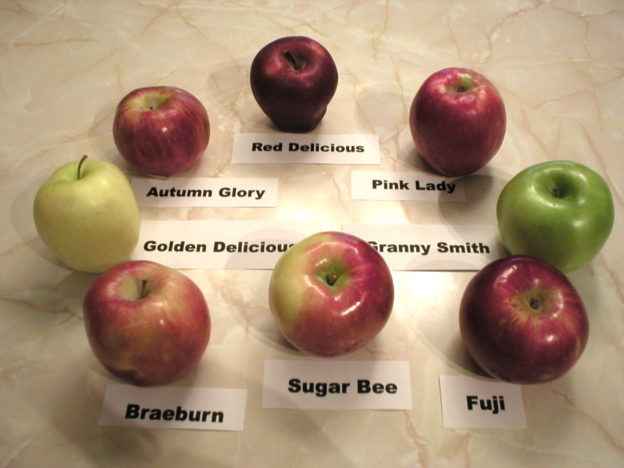
Apples 101 – The Basics
About Apples
We’re all familiar with apples. They can be found in just about any grocery store and are even seen in some convenience stores. There are literally thousands of varieties of apples grown around the world today. It’s not unusual to see many different varieties of apples being sold in any one grocery store, all at the same time. Assorted varieties differ in size, color, texture, flavor, and aroma. Some are crispier than others. Some are sweet, while others have a tart flavor, and some have a combination of a sweet-tart flavor. The colors can vary from yellow, green, red, gold, pink, scarlet, almost purple, to multi-colored. The apple flesh color can also vary from being stark white to a pale shade of the color of the skin.
Apples belong to the Rosaceae family of plants. This broad family of plants also includes apricots, cherries, loquats, peaches, plums, raspberries, strawberries, and even roses.
Apples appear to have originated in the mountains of Central Asia. Once discovered, they were quickly domesticated and carried to parts of Western Asia and Europe, where they were cross-bred with other species of wild apples. This cross-breeding paved the way for apples having the wide diversity and ability to withstand different habitats that they share today.
Currently, China is the world’s largest producer of apples, followed by the United States, Turkey, Poland, Italy, India, France, Chile, Iran, and the Russian Federation. The United States exports about 25 percent of its production of apples. The most popular varieties of apples grown in the United States include Empire, Fuji, Gala, Golden Delicious, Honeycrisp, Granny Smith, McIntosh, Red Delicious, Rome, and Pink Lady.
Today, apples are the second most popular fruit in America, second only to bananas. With that, grocery stores strive to be well-supplied with fresh apples year-round. To help boost the supply of apples in America so they can be sold year-round, about 5 percent of the supply is imported from other countries including Chile, Canada, and New Zealand.
Nutrition and Health Benefits
Apples are a good source of fiber, both soluble and insoluble. They are also a good source of Vitamin C. Apples also contain some Vitamins B1, B2, B6, E, and K, along with biotin, pantothenic acid, chromium, copper, magnesium, manganese, phosphorus, and potassium. It is worth noting that a lot of the nutrients found in apples are in the skin. So, it’s worth eating the peel of apples, if possible.
Apples are also particularly high in an array of phenols and polyphenols, which are phytonutrients that provide an array of health benefits through their antioxidant protection.
Cardiovascular Benefits. Many animal and human studies have been conducted on the cardiovascular benefits of apples. One study found that eating one apple a day for four weeks significantly lowered blood levels of oxidized LDL cholesterol, which was associated with a lowered risk of atherosclerosis.
A number of studies linked apples with overall lower levels of LDL cholesterol, not just oxidized LDL cholesterol. This may be due to the soluble fiber in apples binding with bile in the intestinal tract, removing it with the feces. This forces the body to make more bile from existing cholesterol, thereby lowering blood cholesterol.
Furthermore, studies have found that not only was LDL cholesterol lowered in those who ate apples, but total cholesterol and triglycerides were also reduced. This appeared to be due not only to the fiber in apples, but also to the phytonutrients in the fruit.
Other Benefits of Apples. Some of the fiber in apples is in the form of pectin, their main type of soluble fiber. Pectin is known to help control the rate at which the stomach empties and the pace at which the contents travel through the intestinal tract. Pectin slows down these times, delaying hunger, and stabilizing blood sugar metabolism. One of the phytonutrients in apples, phloretin, has been studied individually, and has been found to help stabilize blood glucose levels, plasma insulin levels, and lessen insulin resistance.
Apples have also been studied for their potential role in helping to prevent colon cancer. Most of the current research has been on animals and laboratory cell studies. However, researchers have found that components in apples do make their way to the lower bowel, which is showing promising results in their research about apples lowering the risk for colon cancer.
How to Select Apples
Choose firm apples with rich color, while keeping in mind that the color varies a lot between varieties of apples. Avoid apples with soft spots, bruises, or damage.
Organic vs Conventionally Grown Apples. Apples that are conventionally grown are sprayed with a cocktail of chemicals to ward off insects, fungus, and diseases as they grow. Additionally, conventionally grown apples are often sprayed with chemicals after being harvested to prevent problems (such as brown or black patches) during cold storage. Because researchers find that harvested apples are often laced with assorted chemicals, apples are near the top of the Environmental Working Group’s “Dirty Dozen List” each year.
To avoid the ingestion of these chemicals, buying organic apples is an option. However, they are more expensive than conventionally grown apples, and they are not stocked in all grocery stores. If you are concerned with such chemicals in your food supply, yet the higher cost or availability of organic apples is not an option for you, there is yet another way to get around this problem. See the section “How to Remove Chemical Residues from Apples” in this article.
Flavor. There are many varieties of apples on the market, and those varieties may vary from season to season, depending upon how long they can be stored. If you’re looking for a traditionally mellow but sweet apple, Red Delicious is one option that is always available in the United States. If you’re looking for flavor in the opposite end of the spectrum, Granny Smith apples are known for their tartness and are commonly found in most grocery stores year-round. Most other apples fall somewhere in between the very sweet and very tart flavors. If you’re not sure what the flavor of a particular variety of apple is, check the list below. If your apple in question is not on the list, ask the produce manager in your local store. He/she should have the information you need.
How to Store Apples
Apples may be stored at room temperature or in the refrigerator; however, they will keep longer in the refrigerator. When apples are in “cold storage” after being harvested and before arriving at your local store, they are usually kept at a temperature very close to freezing. Your refrigerator will normally be a little above that temperature range. Therefore, placing your apples in the refrigerator will help to extend their shelf life, as opposed to storing them at room temperature. Apples should keep well in the refrigerator for several weeks, and maybe longer, depending upon the variety. For example, Granny Smith apples tend to keep longer than most other varieties. Apples will keep best in the crisper drawer set on low humidity (with the air vent opened).
If you notice an apple with a bruise or one that is slightly damaged, do not store it near your other apples. Bruised or damaged apples will release more ethylene gas than undamaged apples. When stored around other fruit, this excess ethylene gas will cause nearby fruit that is sensitive to the gas, like other apples, to age faster than normal. So, store damaged fruit separately and use them as quickly as possible.
How to Prepare Apples
Simply wash your apples very well before using. They may be eaten whole, quartered, sliced, diced, peeled, or unpeeled, and eaten raw or cooked. Prepare them as needed for your specific recipe. The skin of apples is rich in fiber and phytonutrients, so consider eating them with the peel on, if at all possible. If your apples were conventionally grown, and the presence of chemical residues on the surface is a concern to you, the residue may be removed by following the steps detailed in the next section.
If you need to cut your apples a little in advance, they will have a tendency to turn brown. This can be avoided by placing your cut pieces in a bowl of cold water to which a tablespoon of lemon juice has been added.
How to Remove Chemical Residues from Apples
There is a scientifically proven method for removing most of the chemicals from the surface of conventionally grown apples. This method will not remove chemicals that have soaked into the apple itself, but it is effective at removing chemicals off the surface. It’s a matter of soaking the apples in a baking soda solution (1 teaspoon of baking soda to 2 cups of water) for 12 to 15 minutes. This is a simple and inexpensive way to clean apples that is more effective at removing chemical residues than just rinsing them under water. To learn more about this method, watch my video demonstration on how to soak apples for this purpose… https://youtu.be/AsUAD6EWyzw
How to Preserve Apples
Freezing Apples. Fresh apples may be frozen whole or cut. Bear in mind that when thawed, their texture will be soft and not suitable for eating as if they were fresh. They will need to be cooked in some way. Apples may be frozen whole. Simply wash and dry them, then place them on a tray in the freezer so they can freeze separately. Once frozen, transfer them to a freezer bag or container.
Apple slices may also be frozen. Wash, peel, and core the apples, then slice them. Place the apples in a lemon juice solution (1/4 cup lemon juice to 4 cups of water) or an ascorbic acid (Vitamin C) and water solution first to keep them from turning brown. Use 1 teaspoon of ascorbic acid in two cups of water. Allow apples to soak in either solution for about 5 minutes. For the record, the ascorbic acid solution will be more effective and will not add flavor to the apples as will the lemon juice solution.
Instead of soaking apple slices to prevent browning, they may also be blanched for one minute prior to freezing. Once treated, arrange the slices in a single layer on a parchment-lined baking sheet or tray and place them in the freezer. Once frozen, transfer them to an airtight container or freezer bag.
Frozen whole and sliced apples can be used to make apple butter, applesauce, jam, jelly, pies, cakes, cobblers, baked apples, and other baked or cooked dishes.
Apple pie filling may also be frozen to be baked later. Prepare your pie filling as usual and place it in a pie plate that was lined with plastic wrap. When the filling is frozen, transfer it to a freezer bag. Note that some spices will lose some flavor during freezer storage, so it may be helpful to slightly increase your seasonings when freezing prepared apple pie filling.
To use your frozen apple pie filling, do not thaw it out before baking. Simply place it in a dough-lined pie pan. Cover it with a pie-dough top, making sure it has vent holes to allow steam to escape during the baking process. Bake as directed, adding about 20 minutes to the baking time because of the frozen filling.
For best quality, as long as the apples were kept at 0°F or below, use frozen apples within one year. If your freezer does not maintain that temperature, use them within 3 to 6 months for best quality. They will be edible beyond that, but their quality may dwindle over time. If you notice dry spots or discoloration on your frozen apples, they will still be edible, but the flavor and texture will be diminished.
Dehydrating Apples. To dehydrate apples, peel the apples, if desired, and remove the core. Cut crosswise into rings about ¼ inch thick, or slice them as desired. The apple slices must be pretreated to prevent them from browning. They may be dipped in a lemon juice solution of ¼ cup lemon juice in 4 cups of water. Allow them to soak for about 10 minutes, then drain off the excess liquid. Or, instead of lemon juice, you can use a commercially prepared product such as Fruit-Fresh. Follow the directions on the package for pretreating apples.
Place the apple pieces on a mesh drying tray and dry at 130°F for 5 to 6 hours, or until they feel dry and leathery. They should feel spongy and still be flexible. Also, check the manufacturer’s instructions for drying apples with your specific dehydrator.
When drying apples, it is advisable to choose an apple variety that still has a good flavor after being heated. Examples include Granny Smith, McIntosh, Crispin, Cortland, and Northern Spy apples. Many apples that are suited mostly for fresh eating, such as Royal Gala, don’t have a lot of flavor once dried.
Quick Ideas and Tips for Using Apples
* Make an apple cobbler with a walnut crust. Top with a vanilla sauce.
* Make an apple and celery salad with a hazelnut vinaigrette dressing.
* Don’t peel your apples, if you can. Apple peels are full of antioxidants and fiber!
* Use applesauce in place of fat in baked goods. Using unsweetened applesauce is best so it doesn’t alter the sweetness ratio of the recipe. Applesauce may be used to replace oil in quick breads and muffins on a 1 to 1 basis (1 part of oil is replaced with 1 part of applesauce). However, it’s important to know that the texture of the baked product will change. It’s best to first test it out by replacing half of the oil with applesauce. If it meets your expectations, you can experiment further from there.
* Add diced apples to any fruit salad.
* Braise a chopped apple with red cabbage.
* Enjoy sliced apples and cheese for a European-style dessert.
* Apples can pick up the flavor of other foods that are stored nearby. So be on the safe side and don’t store them near cabbage or onions!
* One 9-inch pie usually requires about 2 pounds of apples. That’s about 6 medium-size apples.
* Don’t keep bruised or rotting apples near other apples. One bad apple REALLY CAN spoil the whole bunch.
* Add grated apples to pancake batter for added natural sweetness and a fruity flavor. Add a little cinnamon to enhance the flavor even more. It may help you to cut back on the maple syrup topping.
* Top apple slices with your favorite nut butter for a healthy, satisfying snack.
* Are you having a party? Use apples as a place setting marker on the table. Make a small cut across the top of washed apples. Insert a name tag into the slit of each apple and place an apple in the center of each plate.
* If you have apples that are aging and turning soft, turn them into applesauce. Simply peel the apples and cut them up into a pot. Add a little water, cinnamon, and sugar, if needed. Cook them until they are soft and mash them up if needed. You’ll have fast, homemade applesauce!
* Add cut fresh apples to any green salad. Top with a fruit-based dressing to bring out the sweetness of the apples.
* To keep fresh, cut apples from turning brown, simply place the pieces in a bowl of cool water with a tablespoon of lemon juice.
Herbs and Spices That Go Well with Apples
Allspice, cardamom, caraway seeds, cayenne, cinnamon, cloves, coriander, fennel seeds, ginger, horseradish, lavender, mace, mint, mustard seeds, nutmeg, pepper, rosemary, sage, sorrel, vanilla
Foods That Go Well with Apples
Proteins, Legumes, Nuts, Seeds: Almonds, beef, cashews, chestnuts, chicken, eggs, hazelnuts, lamb, lentils, nuts (in general), peanuts, peanut butter, pecans, pine nuts, pistachios, pork, sausage, salmon (seafood), sesame seeds, sunflower seeds, turkey, veal, walnuts
Vegetables: Beets, cabbage (esp. red), carrots, celery, celery root, chiles, cucumbers, endive, fennel, greens (salad), jicama, kale, lettuce, onions, parsnips, rhubarb, sauerkraut, spinach, squash (winter), sweet potatoes, watercress, zucchini
Fruits: Apricots, bananas, blackberries, blueberries, cherries, coconut, cranberries (dried and fresh), currants, dates, figs, fruit (dried, in general), grapes, lemons, oranges, pears, plums (dried and fresh), pumpkin, quince, raisins, raspberries
Grains and Grain Products: Amaranth, farro, grains (in general), kasha, millet, oats, oatmeal, phyllo dough, quinoa, rice (esp. basmati, brown, wild), wheat berries
Dairy and Non-Dairy: Butter, buttermilk, cheese (esp. blue, cheddar, cream, feta, goat, Gorgonzola, Roquefort), cottage cheese, cream, mascarpone, ricotta cheese, sour cream, yogurt
Other Foods: Agave nectar, brandy, butterscotch, caramel, honey, maple syrup, molasses, mustard (prepared), oil (esp. nut), spirits (i.e. brandy, cognac, kirsch, rum, sherry, vermouth), sugar (esp. brown), vinegar (esp. cider), wine (red)
Apples have been used in the following cuisines and dishes…
Apple butter, applesauce, baked apples, baked goods (i.e. cakes, muffins, pies), brandy, chutneys, compotes, crepes, custards and flans, desserts (i.e. cobblers, crisps, crumbles), granola (esp. dried apples), juices, muesli, puddings, salads (fennel, fruit, grain, green, Waldorf), soups (i.e. butternut squash, sweet potato), stuffing, trail mix (esp. dried apples)
Suggested Food and Flavor Combos Using Apples
Add apples to any of the following combinations…
Allspice + cinnamon + cloves + ginger + maple syrup + orange
Almonds + cinnamon + rosemary
Apple cider vinegar + greens + maple syrup + walnut oil
Blue cheese + celery
Brown sugar + caramel + cinnamon
Caramel + nuts (i.e. peanuts, pecans)
Cheese (i.e. blue) + greens + nuts (i.e. pecans, walnuts)
Cinnamon + cranberries + ginger + maple syrup + raisins + walnuts
Cinnamon + dates + oatmeal
Cinnamon + honey + lemon
Cinnamon + honey + vanilla + yogurt
Cinnamon + maple syrup + mascarpone
Cinnamon + nuts (i.e. walnuts) + raisins
Cloves + cranberries + oranges
Cucumbers + mint + yogurt
Fennel + walnuts
Figs + honey
Grains (i.e. oats, quinoa, wild rice) + nuts (i.e. walnuts )
Maple syrup + vanilla + walnuts
30 Apple Varieties Found in the United States
Here is a list of some of the apple varieties found in the United States. It’s simply not possible to list them all because there are so many out there, and new varieties are being discovered and developed regularly. Also, some varieties are very popular in specific locations, while unheard of elsewhere. So, if you have a favorite apple that was not included in this list, forgive me! It’s simply not possible to list them all. They are listed alphabetically, not ranked according to flavor or texture profiles.
Ambrosia Apples
Ambrosia apples were discovered in British Columbia, Canada in the 1990s. They are believed to be a cross between Jonagold and Golden Delicious apples. They are medium to large apples, with a conical shape. Today, Ambrosia apples are grown in the United States, Canada, Chile, Europe, and New Zealand.
Characteristics: Ambrosia apples are tender and juicy, with low acidity, a sweet, honey-like flavor, and a pleasant floral aroma. The flesh is a light yellow to cream color.
Best Uses: Ambrosia apples are slow to brown when cut and hold their shape well when cooked. Those two properties make them excellent apples to enjoy raw, out of hand and cut in salads. They are also excellent roasted with root vegetables, or diced and added to polenta, couscous, or rice. They will add sweetness and moisture to baked goods like cakes, muffins, and doughnuts. They hold their shape and flavor when baked, so they are excellent in pies, tarts, and baked apples. Thin slices can be used to adorn a burger or sandwich. Ambrosia apples pair well with sharp cheeses.
Autumn Glory Apples
Autumn Glory apples were developed by Domex Superfresh Growers in 2011, in Washington state. As production increases, Autumn Glory apples are gradually making their way across the country. Autumn Glory apples are a cross between Fuji and Golden Delicious apples. They are currently available mid-fall through spring.
Characteristics: The flesh of Autumn Glory apples is yellow, firm, crisp, coarse, and very juicy. The aroma is cider-like, while the flavor is like baked apple pie with caramel and cinnamon notes. Autumn Glory apples do not have much acidity. They will keep in the refrigerator or another cool, dry place for several weeks.
Best Uses: Autumn Glory apples are perfect for eating fresh, out of hand or cut in salads. They may be cooked in sweet or savory dishes, and also included in baked goods. They make sweet applesauce. Autumn Glory apples pair well with strong cheeses.
Braeburn Apples
Braeburn apples originated in New Zealand in 1952. They were discovered rather than bred, which means they were naturally pollinated. It is assumed their parents are the Lady Hamilton and Granny Smith apples. Braeburn apples are now grown in the United States, except in the northernmost parts of the Midwest and New England. They are one of the top apples grown in Washington state.
Characteristics: Braeburn apples are thin-skinned, with a “textbook” apple flavor with the perfect balance between sweet and tart. Their pale yellow, crisp and juicy flesh is spicy-sweet with faint hints of cinnamon and nutmeg.
Best Uses: Braeburn apples are excellent eaten raw, out of hand or cut and added to salads. They may be used in cooking and in making fruit juices. Their sweetness mellows when cooked, so they are also a good choice for savory applications like being cooked with meat such as pork chops. Braeburn apples hold their shape well when heated so they are excellent as a baked apple, and when included in pies and other desserts.
Cameo Apples
Cameo apples were discovered growing in an orchard in Washington state in the 1980s. They are now grown across the country, but most commercial production is in Washington state. They are believed to be “relatives” of Red and Golden Delicious apples.
Characteristics: Cameo apples have a thin, delicate skin. The flesh is dense, creamy white to yellow in color, and crisp and juicy, with a bright citrus-like flavor with notes of honey. The flavor is considered to be the perfect balance between sweet and tart. Unlike many other apples, Cameo apples don’t brown quickly when cut.
Best Uses: Since they don’t brown quickly after being cut, Cameo apples are ideal for fresh applications, like being added to salads and cheese trays. Their texture holds up well when cooked. Furthermore, their sweetness is enhanced when cooked, so they are excellent in pies, crisps, cobblers, and other desserts. They can also be used in savory applications such as quiche, polenta, and other such dishes. They pair well with squash, bacon, pears, and flavorful cheeses such as goat, cheddar, and ricotta. They can even be used as a pizza topping.
Cortland Apples
Cortland apples were first produced in New York state in 1898. They were named for Cortland County, New York and have become one of the most commonly grown apples in the state of New York. They are a cross between McIntosh and Ben Davis apples.
Characteristics: Cortland apples are bright red with a crisp, white flesh that is very juicy with a sweet-tart flavor. Cortland apples do not brown as quickly as some apple varieties. They are at their best when eaten soon after being picked, because the flavor and crispness dwindle with age. Since they do not store well, they should be used soon after being harvested for best flavor and texture.
Best Uses: Cortland apples may be eaten raw and cut in salads. They may also be used in any cooking or baking application, including cakes, tarts, cobblers, quiches, soups, sauces and preserves. They may even be made into juice and cider. Since they are slow to turn brown, they may be sliced thin and added to sandwiches, burgers, and quesadillas. They may be used with dips in place of crackers. Cortland apples pair well with cheeses.
Cosmic Crisp Apples
Cosmic Crisp apples are an American apple that is a cross between Honeycrisp and Enterprise apples. They were developed by Washington State University and are only grown in Washington state.
Characteristics: Cosmic Crisp apples are large, red, crunchy, juicy, acidic, and sweet. They don’t brown as quickly as many other apple varieties. Cosmic Crisp apples have an extended shelf life, with some resources claiming they will stay fresh in the refrigerator for up to a year! So, if you like to “buy ahead,” this is the apple go get.
Best Uses: Cosmic Crisp apples may be eaten fresh or cut in salads. They hold their shape well when heated, so they may also be baked, roasted, sautéed, and cooked pretty much any way you would want to cook an apple. Since they retain their sweetness when heated, including when in cooked or baked, these apples can possibly allow for reduced added sugars in recipes. Their high sugar content allows them to caramelize well when roasted. When baking Cosmic Crisp apples in a pie, combine them with tart and softer apples for best flavor and texture outcome.
Crispin Apples
Crispin apples were originally named the Mutsu apple when they were developed in Japan in the 1930s. They are a cross between Golden Delicious and Indo apples. They were renamed to Crispin when they were taken to America and the U.K. in the late 1940s. Today, they are grown and marketed around the world and are sold under both names. They are available during the fall months.
Characteristics: Crispin apples are large, juicy, and very crisp, with a sweet and slightly tart flavor with notes of honey. They are a green-skinned apple.
Best Uses: Crispin apples are versatile. They are excellent eaten fresh, out of hand, and cut in salads. They can also be baked, and included in pies and other such desserts, and also cooked into applesauce.
Empire Apples
Empire apples were introduced in the 1960s in the state of New York. They are a cross between Red Delicious and McIntosh apples.
Characteristics: Empire apples are medium in size with a thin skin. Despite that, they do not bruise easily. The flesh is creamy white. They are juicy, crisp, and sweet-tart.
Best Uses: Empire apples can be enjoyed fresh, eaten out of hand or in salads and slaws. They may also be made into applesauce since their flesh breaks down easily when cooked. They are not suitable for pies and other such desserts. Empire apples pair well with sharp cheese, pears, pumpkin, and warm spices like cinnamon and nutmeg.
Enterprise Apples
Enterprise apples are a North American apple developed in 1982 at Purdue University. They were named and released in 1992.
Characteristics: Enterprise apples are medium to large in size. The skin is smooth, tough, thick, and glossy red in color with a yellow or green background. The pale, yellow flesh is crisp, juicy and firm. Their flavor has been compared to that of a Fuji apple. Enterprise apples store exceptionally well, up to six months in the refrigerator.
Best Uses: Enterprise apples are versatile. They are commonly used for candied apples, so they are popular around Halloween. They may be eaten fresh and cut in salads. They are especially recommended as a cooking and baking apple. Make applesauce with Enterprises, or bake them into pies and cakes flavored with cinnamon and cardamom.
Fuji Apples
Fuji apples were first harvested in Japan, where they are still very popular. They are a cross between Red Delicious and Virginia Ralls Janet apples, both American varieties. They were first introduced in the United States in the 1980s. Today, the United States grows more Fuji apples than Japan. Fuji apples are among the most commonly grown apples around the world.
Characteristics: Fuji apples are dense and crisp, with creamy white flesh. The apples are well-known for their exceptional sweetness, low acidity, juiciness, firmness, and crispiness. They are said to have notes of honey and citrus. Some people consider them to be the sweetest of all apple varieties. Fuji apples have a long shelf life.
Best Uses: Fuji apples are excellent eaten raw, out of hand, or chopped and included in salads. They may be cooked in a variety of ways. They may be baked since they retain their shape. They may also be roasted or boiled. They work well in both sweet and savory dishes such as pies, strudels, pizza toppings, quiches, sauces, soups, salads, curries, candied apples, and made into apple wine, apple juice, and jam. Fuji apples pair well with sharp cheese.
Gala Apples
Gala apples originated in New Zealand in the 1930s, and were first brought to market in 1965. They are a cross between Kidd’s Orange Red and Golden Delicious apples. They were brought to the United States in the 1980s and have become one of Americas most popular apples. They can be grown in both warm and cold climates, so they are grown around the world and in most states in the USA, other than the most southern areas. Gala apples are available year-round.
Characteristics: The skin is thin, while the creamy yellow flesh is dense, crisp, juicy, fragrant, and slightly sweet with hints of vanilla.
Best Uses: Gala apples are ideal when eaten raw, out of hand, or cut and included in salads. They are excellent in fruit salsas and chutneys. They can be sliced and added to burgers, paninis and crostinis. They are best when used in fresh applications, but they may also be juiced and cooked into sauce. Their sweet flavor mellows when cooked, so they should be paired with stronger flavored apples such as a Granny Smith or Pippin apples when used in baked goods. Gala apples pair well with pears, winter squash, onions, pecans, turkey, curry, brie, cheddar, and Swiss cheeses.
Golden Delicious (also called Yellow Delicious) Apples
Golden Delicious apples originated in West Virginia, USA, where they are now the official state fruit. Despite their name, Golden Delicious apples are not related to Red Delicious apples. Instead, they are believed to be a cross between Grimes Golden and Golden Reinette apples. They were first brought to market in 1914. They are among the most commonly found apples in American grocery stores. They are harvested from autumn through winter.
Characteristics: Golden Delicious apples are large, and yellow-green in color. The flesh is white, crisp, and firm. They are mildly sweet, slightly tart, juicy, and aromatic. They taste very similar to Red Delicious apples.
Best Uses: Golden Delicious apples are best eaten fresh, out of hand, or cut and included in salads. They may also be made into applesauce and apple butter. They may be baked into desserts. Golden Delicious apples also pair well with savory foods such as cabbage and pork. Because of their mild sweetness, Golden Delicious apples are often paired with Granny Smith apples in pies.
Granny Smith Apples
Granny Smith apples were actually discovered by a lady, “Granny” Maria Ann Smith, who found the little apple tree growing in her compost pile in her orchard in Australia in the 1860s. They have since become one of the most popular apples in the world. They were originally cultivated in Australia, but are now grown in the United States below the Mason-Dixon Line. They are available year-round. Granny Smith apples are sturdy, neon green, and the most common green apple in America.
Characteristics: Granny Smith apples are known for their tartness. Their flavor reminds some people of lemons. They are crisp, juicy, and firm, with a bright white flesh. They are said to sweeten some with age.
Best Uses: Granny Smith apples can be eaten raw, and cut and included in salads where their tartness can be offset with other ingredients. Granny Smith apples pair exceptionally well with nut butters and sharp cheese. They are excellent apples to include in pies because they hold their shape well when baked. They are also often used in muffins, pancakes, cakes, cobblers, and tarts. They can even be included in soups and stuffings.
Honeycrisp Apples
Honeycrisp apples are the official state fruit of Minnesota. They were developed at the University of Minnesota in the 1960s, where they were striving for a sweet-tart, crisp, juicy apple. They were first marketed commercially in the 1990s. Honeycrisp apples are currently grown in the northern Great Lakes and New England areas.
Characteristics: Honeycrisp apples are crispy and juicy. Their flavor is a balance of sweet and tangy that is pleasing to many people.
Best Uses: Honeycrisps are an exceptional apple when eaten raw, or in salads. Their crispness adds wonderful texture to slaws and other salads, and even sandwiches. Honeycrisp apples retain their sweetness when cooked, which makes then an excellent choice for baked apples, pies, and other desserts.
Idared Apples
Idared apples were developed in Idaho. They are a cross between Jonathan and Wagener apples. They are medium size with bright red and green colors.
Characteristics: The flesh is juicy, crisp, and firm, while the flavor is sweet, tart, aromatic, and refreshing.
Best Uses: Idared apples can be eaten raw and in salads. They pair well with strong blue cheese, and also Roquefort cheese. They may also be cooked and baked because they hold their shape well.
Jazz Apples
Jazz apples were cultivated in recent years in New Zealand. They are a cross between Royal Gala and Braeburn apples. In the United States, Jazz apples are grown in Washington State, where they are in season from July to September.
Characteristics: Jazz apples are very crisp, with dense, firm, buttery yellow flesh that is very juicy. They are low in acid and have a flavor similar to pears.
Best Uses: Jazz apples hold their shape well when baked, so they are perfect in pies, muffins, and tarts. They also work well with savory dishes like roasted root vegetables, pork, roast chicken and soups.
Jonagold Apples
Jonagold apples were first developed in New York state in 1968. They are a cross between Golden Delicious and Jonathan apples. They require specific growing conditions of a mildly cool climate, which has allowed them to be extremely successful in Western Europe. They are grown in the United States, but not on a wide scale. They are available in early fall.
Characteristics: Jonagold apples are big, crisp and juicy with a sweet-tart flavor with notes of honey.
Best Uses: Jonagold apples are ideal for cooking and can be baked in pies, cakes, muffins, and tarts. They work well as baked apples. Their flavor blends well in jams, preserves, and sauces. Also, their sweet-tart flavor complements savory applications, so they may be served as sautéed slices with pork or root vegetables. They may even be roasted along with vegetables. They pair with robust cheeses and may be used on sandwiches, pizza or cheese trays.
Jonathan Apples
It is believed that Jonathan apples originated in Woodstock, New York in 1826. After receiving a series of different names, it was eventually named “Jonathan” and has kept that name ever since. Today, Jonathan apples are grown in cold to moderate climates around the world. This apple has been used as a “parent” to a number of other apples including the Jonagold apple. At one time, Jonathan apples were a very important commercial crop. Over the years, newer varieties of apples crowded Jonathan apples from the limelight. However, with the growing popularity of heirloom varieties, Jonathan apples are making a comeback. They are available in the fall and are best if eaten by Christmas if they were kept in cold storage.
Characteristics: Jonathan apples are medium size with a thin skin. The creamy yellow flesh is juicy and crisp, with a mildly sweet-tart flavor with hints of spice.
Best Uses: Jonathan apples may be eaten fresh or cooked. This apple may be used in tarts, purees, soups, pies, and sauces. The flesh breaks down slightly when cooked, so they are often paired with Granny Smith, Pippin, or Fuji apples in baked goods. The slightly spicy flavor works especially well when Jonathan apples are made into juice or cider. Jonathan apples also work well in savory applications, such as being added to couscous.
McIntosh Apples
McIntosh apples originated in Upper Canada in 1811, when a seedling was discovered growing on the farm of John McIntosh. Mr. McIntosh transplanted the little tree by the family’s home. When it matured, it was found to produce exceptional fruit. Commercial production started in 1870. McIntosh apples are now grown throughout the northeastern United States, the upper Great Lakes states, and in eastern Canada.
Characteristics: They have a beautiful red and green color, and a balance of sweet and tart/acid in their flavor. Interestingly, the flavor of McIntosh apples can vary depending upon when the apples were picked. Those picked in early winter will be slightly sweeter than those picked in the fall, when they’ll have a stronger sweet-tart flavor with hints of spice. When first harvested, the flesh of McIntosh apples is crisp. However, with age, their skin and white flesh soften and become more tender when compared with some other apple varieties.
Best Uses: McIntosh apples are best eaten fresh, or cut and included in salads. They may be cooked into applesauce since their flesh doesn’t hold together well when cooked. When using them in pies or tarts, they should be paired with sturdier fruit such as a Granny Smith, Rome, or Fuji apples. They may be chopped and added to stuffings and soups. McIntosh apples may also be juiced and turned into cider. The flavor of McIntosh apples pairs well with maple, pecans, celery, pork, blackberries, cherries, cinnamon, nutmeg, and flavorful cheese such as Gorgonzola feta, and sharp cheddar cheese.
Northern Spy Apples
Northern Spy apples originated in the 1800s in New York state. The apples grew in popularity throughout New York and into northeastern growing regions. Today, the Northern Spy apple is grown mainly in the northeast United States, and also in a few specialty orchards on the west coast. They are available in the fall, and may be stored up to three months in a cool, dry place.
Characteristics: Northern Spy apples are a late season apple that is very large and stout, and is red with streaks of yellow and pale green. The creamy-yellow flesh is tender-crisp and juicy. It is slightly tart with a flavor like cider with hints of pear and sweetness.
Best Uses: Northern Spy apples are versatile. They can be enjoyed fresh, out of hand or cut in salads. They may be cooked in any way imaginable, such as in pies, tarts, cobblers, baked, roasted, sautéed, or slow cooked into sauces. They are excellent served on a cheese tray with nuts and honey. Northern Spy apples are an excellent choice for making into cider.
Opal Apples
Opal apples are relatively new on the market. They are a cross between Golden Delicious and Topaz apples and were developed in the Czech Republic in the 1990s. They were brought to the United States in 2010. In America, they are grown only in Washington state, but are marketed across the country. They are bright yellow, somewhat resembling Golden Delicious apples. Interestingly, Opal apples have been certified as being non-GMO, and a portion of the proceeds from their sale is devoted to supporting community programs, such as creating and maintaining community gardens in local underserved communities. Buy Opal apples and support a worthy cause! Opal apples may be kept in the refrigerator for up to three months.
Characteristics: Opal apples are a medium to large, round fruit, that can weigh as much as 14 ounces! They have retained the flavor profiles of their parents with a nice blend of sweet and tart. They have a lemon-yellow skin with rust appearances toward the stem. The cream-colored flesh is soft yet crisp, with a sweet flavor and a slightly tart finish. The flavor of Opal apples has been described as that of Honeycrisp apples with hints of pear, coconut, and banana. A distinctive characteristic of this apple is that when cut, it doesn’t brown like other apples.
Best Uses: Opal apples may be eaten raw or cooked. Since they do not turn brown, they are excellent additions to fresh applications like salads, sandwich toppings, or cheese trays. Opal apples are at their best when eaten fresh. However, their crisp texture holds up well when baked in pies, tarts, cobblers, and crisps. They may also be added to cakes and muffins.
Pacific Rose Apples
Pacific Rose apples are a cross between Gala and Splendour apples. They originated in New Zealand and were named for their pretty rose color and the ocean that surrounds the island. The apple was brought to America in 1996. They are now grown both in New Zealand and Washington state. They are available from Washington state November through April, and from New Zealand late May through October.
Characteristics: Pacific Rose apples have a refreshing, sweet flavor with crisp flesh.
Best Uses: Pacific Rose apples are primarily eaten fresh, out of hand or cut in salads, sandwiches, and desserts. They may also be served as baked apples, and included in baked goods such as pies. They may also be made into applesauce. Pacific Rose apples pair well with wine and cheese.
Piñata Apples
Piñata apples were created by researchers in Germany in the 1970s. They are unusual in that they are a cross breed of three varieties of apples, rather than two: Golden Delicious, Cox’s Orange Pippin, and Duchess of Oldenburg. They were released for sale in 1986 and sold commercially in Europe until 2004, when growing rights were purchased by Stemilt growers in Washington state. In 2010, the company released the apples to the American market. Like many other varieties, Piñata apples are grown exclusively in Washington state.
Characteristics: Piñata apples are medium to large, with an orange glow with red stripes over a yellow background. The skin is thin, and the white, fine-grained flesh is crisp and juicy. They have a unique flavor, described as a classic apple taste with tropical notes of banana, pineapple, honey, and coconut. They have a sweet-tart flavor comparable to that of a Fuji, Braeburn, or Gala apple. They do not turn brown quickly.
Best Uses: Piñata apples are mostly eaten raw, considering their preferred sweet-tart flavor among apple lovers. Since they don’t turn brown quickly, as do most apples, they are excellent served fresh as a snack, in salads, or on cheese trays. They are exceptional when paired with cheese, or in a savory salad. Piñata apples hold up well when baked or cooked. Their crisp texture and sweet-tart flavor make them an excellent pie apple. They also work well with savory dishes, such as stuffed pork tenderloin.
Pink Lady (also called Cripps Pink) Apples
Pink Lady is the brand name for the Cripps Pink variety of apples that are grown under a specific license, dictating a certain sugar-to-acid ratio, among other traits. Those that don’t qualify are sold as Cripps rather than Pink Lady apples. Pink Lady apples are a cross between Golden Delicious and Lady Williams apples and were developed in Australia in the late 20th century. In the United States, they are mainly grown in Washington state and California.
Characteristics: Pink Lady apples have a crisp, slightly dry, firm, creamy white flesh. They have a tart flavor that finishes with sweetness. Pink Lady apples are slow to oxidize (turn brown), so they are excellent for applications where they need to be cut in advance and served fresh.
Best Uses: Pink Lady apples are usually consumed fresh, when the flavors are sweet and slightly sharp. They are excellent raw, out of hand, and in salads. They may also be baked into pies, and cooked into sauce. They pair with cheese exceptionally well.
Pippin Apples
Pippin apples are believed to have originated as a “chance” seedling in Newtown, New York in the late 18th century. Pippin apples quickly caught on and they were among the first apples to be cultivated in the United States. George Washington and Thomas Jefferson cultivated Pippin apples on their home estates. In the 19th century, Pippin apples were exported to London, where they became a favorite of Queen Victoria. They lost popularity in America as other apple varieties were developed and marketed. Today, Pippin apples are grown on a relatively small scale in California, Washington state, Oregon, New York, and Virginia.
Characteristics: Pippin apples are round to oblong, with a slightly lopsided shape. Their color ranges from light green to yellow-green, with an occasional pink blush. The flesh is crisp, pale green to white, juicy, and aromatic. They are tart when harvested, and their flavor mellows with age. Sugars develop in the apples as the tartness mellows, resulting in a sweet-tart flavor with notes of pine, citrus, walnut, and green tea. They are usually placed in cold storage for 1 or 2 months before marketing, to allow their preferred flavor to develop. Pippin apples turn brown quickly after being cut, so they should be used soon after being prepared. Pippin apples will keep for one to four months when stored unwashed in a cool, dry, and dark place like a refrigerator.
Best Uses: Pippin apples may be eaten fresh or cooked. They are suitable for baking, stewing, roasting, and boiling. They are an excellent apple for pies, cobblers, tarts, muffins, breads, cakes, and turnovers. They may also be dried. Pippins can be made into juice or cider. They pair well with warm spices such as cinnamon, cloves, nutmeg. Pippins also go well with caramel, mustard greens, oranges, apricots, dates, nuts, and Gorgonzola cheese.
Red Delicious Apples
Red Delicious apples are one of the world’s most common apples, dating back to 1880, when they were discovered in Iowa. These were originally known as Hawkeye apples, then Stark Delicious. When Golden Delicious apples came about, they were renamed to Red Delicious. Without a doubt, they are the most commonly found apples in America.
Characteristics: Red Delicious apples were once prized for their sweet flavor. However, some believe that years of breeding to extend the shelf life has changed the flavor to be much less than it once was. Their skin is thick, and the flesh can be slightly crisp to soft, and bruises easily. The flavor is sweet, but very mild. The texture can become mealy with age, giving them a crumbly texture.
Best Uses: Red Delicious apples are best eaten fresh, out of hand or cut up for salads. They do not hold their shape well when baked or cooked, so it is best to eat them raw.
Rome Apples
Rome apples originated in Rome Township, Ohio in 1817. The Gillett family purchased several young apple trees to start an orchard and noticed one tree was different from the others. The tree was planted away from the others and was eventually found to produce exceptional fruit. The tree was grafted many times over and marketed to other growers in the area. Eventually, it was taken across America and has been grown in regions that are suitable for apples ever since. It has been marketed under a variety of names including Rome, Red Rome, and Rome Beauty.
Characteristics: Rome apples are medium to large and may be round, conical, or oblong in shape. They have a yellow base covered in red. The flesh is yellow to creamy white, and is firm, crisp, and dense. They are crunchy with a mild, sweet, and tangy flavor with a slightly floral aroma. The flavor of Rome apples intensifies when cooked, becoming sweeter and rich. Rome apples will keep for a couple months when stored in the refrigerator.
Best Uses: Rome apples hold their shape well when baked, so they are most often used in cooking applications, such as baking, frying, and roasting. They are excellent as baked apples, and in pies, tarts, cakes, breads, and cookies. Rome apples can be used in both sweet and savory dishes. They can be added to stuffing and quiche, and roasted with root vegetables and meats. They can be diced and added to pancake batters. Rome apples may also be slow cooked and made into sauces and soups. Slices may be fried and served as a side dish. Rome apples pair well with pork chops, Italian sausage, poultry, pecans, currants, raisins, cinnamon, and maple syrup.
SugarBee Apples
SugarBee apples were first found growing in an orchard in Minnesota. Since bees did the work of creating the little tree, the growers found the seedling was a cross between a Honeycrisp apple and another undetermined variety. The tree was allowed to grow to maturity and was found to produce a delicious new apple variety that was crisp and sweet. Word of the new apple spread and growing rights were established with Chelan Fresh Orchard in Washington state, where the new apple was named SugarBee, in honor of the known sweet parent, Honeycrisp, and the bee that created the apple. They are now grown exclusively in Washington state and were first sent to market in 2019.
Characteristics: SugarBee apples look like their Honeycrisp parent, having a yellow-orange-green peel with overlaying bright red. They are large and round with a slightly tapered shape. The flesh is creamy white with a coarse, juicy and crispy texture. The flavor is very sweet and aromatic, with some floral notes under the sugar. SugarBee apples store best in the refrigerator and will keep up to several months.
Best Uses: SugarBee apples are versatile, and may be eaten fresh out of hand, or cut in salads. They may also be baked, cooked, and dried. Their shape holds up well when baked, so they are excellent as baked apples and used in pies, cakes, crisps, and strudel. They pair well with the usual warm spices used with apples, such as cinnamon, ginger, and cloves. SugarBee apples may also be used in sweet and savory cooked dishes, and made into applesauce, with little to no added sugar, since they are so sweet. They may also be used in soups, compotes, jams, and even juice and cider.
SweeTango Apples
SweeTango apples were developed at the University of Minnesota. They are a cross between Honeycrisp and Zestar apples. They were first introduced in 2009 and are now found for a short time in early fall across the United States and Canada. SweeTango apples are a “managed” variety of apple with limited growers that are overseen to ensure the apples maintain specific qualities.
Characteristics: SweeTango apples are medium in size with a bright red skin with some yellow. They are sweeter than Honeycrisp apples, with a stark white flesh that is very crispy and juicy.
Best Uses: SweeTango apples are best when eaten fresh, out of hand, or cut in salads. They add extra sweetness and crunch to Waldorf salads. They may also be used in baked applications such as in muffins, pies and tarts since their flavor and texture holds up when heated.
Winesap Apples
The exact origin of Winesap apples is unknown, but they appear to have been brought to America from Europe as a seed. There is documentation from 1917 stating these apples were popular for the production of apple cider in the state of New Jersey. Since it was mainly used in the production of juice and cider, farmers were discouraged from growing Winesap apples since they did not bring as high a price as fresh eating apples. There has been a recent increased interest in heirloom varieties, so Winesap trees have been planted in a number of orchards. Today, they are grown in small to medium orchards in Washington state, Oregon, Georgia and Virginia.
Characteristics: Winesap apples are round and medium in size with a very thick, dark red skin that helps them to store well. Their creamy yellow flesh is crisp, very juicy, sweet-tart and spicy, and does not break down when cooked. They have a distinctive spicy wine-like flavor.
Best Uses: Winesap apples are perfect for juice, cider, sauces and preserves. They can be enjoyed fresh and in salads. They go well with cheese trays. They add moisture and a sweet flavor to breads, muffins, and cakes. They are an excellent cooking apple, and can be baked, sautéed, and roasted. Winesap apples may also be added to stuffing for roasted meats and winter squash. The flavor pairs well in both sweet and savory applications.
Recipe Links
22 Savory Apple Recipes to Make This Fall https://www.allrecipes.com/gallery/savory-apple-recipes/?
Apple-Cream Cheese Squares https://producemadesimple.ca/layered-ontario-apple-cream-cheese-squares/
Apple Butter https://producemadesimple.ca/apple-butter/
Saucy Chicken Apple Sauté https://producemadesimple.ca/saucy-chicken-apple-saute/
Mushroom, Apple, and Walnut Stuffed Acorn Squash https://producemadesimple.ca/mushroom-apple-walnut-stuffed-acorn-squash/
Roasted Apple, Quinoa, and Wild Rice Salad https://producemadesimple.ca/roasted-apple-quinoa-wild-rice-salad/
Roasted Ontario Apple Gravy https://producemadesimple.ca/roasted-ontario-apple-gravy/
40 Sweet and Savory Apple Recipes for Fall https://www.foodandwine.com/fruits/apple/apples
81 Best Apple Recipes: Dinners, Desserts, Salads and More https://www.epicurious.com/ingredients/apple-of-my-eye-gallery
54 Ways to Eat Apples for Every Meal, from Salad to Pie https://www.bonappetit.com/recipes/slideshow/sweet-and-savory-apple-recipes
Apple Cheddar Pie https://www.bonappetit.com/recipe/apple-cheddar-pie
Celery, Apple and Peanut Salad https://www.bonappetit.com/recipe/celery-apple-and-peanut-salad
Apple-Fennel Chicken Salad https://www.bonappetit.com/recipe/apple-fennel-chicken-salad
Crunchy Turnip, Apple, and Brussels Sprouts Slaw https://www.bonappetit.com/recipe/crunchy-turnip-apple-and-brussels-sprout-slaw
Kohlrabi and Apple Salad with Caraway https://www.bonappetit.com/recipe/kohlrabi-and-apple-salad-with-caraway
Apple Salad with Walnuts and Lime https://www.bonappetit.com/recipe/apple-salad-with-walnuts-and-lime
Scallops with Apple Pan Sauce https://www.bonappetit.com/recipe/scallops-with-apple-pan-sauce
Coleslaw with Apple and Yogurt Dressing https://www.bonappetit.com/recipe/coleslaw-with-apple-and-yogurt-dressing
Cabbage and Apple Salad https://www.bonappetit.com/recipe/cabbage-and-apple-salad
No Bake Apple Walnut Tart http://www.whfoods.com/genpage.php?tname=recipe&dbid=67
10-Minute Fig and Fresh Apple Cobbler http://www.whfoods.com/genpage.php?tname=recipe&dbid=242
10-Minute Apple Sundae http://www.whfoods.com/genpage.php?tname=recipe&dbid=291
Yogurt with Fruit http://www.whfoods.com/genpage.php?tname=recipe&dbid=176
Sautéed Brussels Sprouts and Apple Salad https://shop.sprouts.com/recipes/1553
Apple and Pear Spiced Tea https://shop.sprouts.com/recipes/1563
Upside Down Apple Cake (Gluten-Free) https://shop.sprouts.com/recipes/1568
Pink Lady Applesauce with Cardamom and Cinnamon https://www.fifteenspatulas.com/pink-lady-apple-sauce-with-cardamom-and-cinnamon/
Resources
https://www.foodrepublic.com/2016/05/11/what-is-sorrel-and-how-do-i-cook-with-it/
https://producemadesimple.ca/goes-well-apples/
https://spoonuniversity.com/how-to/made-for-each-other-meat-and-fruit-pairings
http://www.whfoods.com/genpage.php?tname=foodspice&dbid=15#howtouse
https://www.whatsonmyfood.org/food.jsp?food=AP
https://www.ewg.org/foodnews/apples.php
https://www.cmiapples.com/uploads/pdf/sales-sheets/sweet-o-meter.pdf
https://www.indianapolisorchard.com/wp-content/uploads/2014/01/Apple-Chart.pdf
https://bestapples.com/varieties-information/varieties/#
https://www.michiganapples.com/Recipes/Usage-Chart
http://www.milesfarmersmarket.com/wp-content/uploads/Produce-Apple-Chart-Uses.pdf
https://baumanorchards.com/apple-chart/
https://www.sprouts.com/healthy-living/comparing-apples-to-apples/
https://www.healthline.com/nutrition/peeling-fruits-veggies#TOC_TITLE_HDR_2
https://www.openfit.com/a-guide-to-the-most-popular-apple-varieties
https://usapple.org/apple-variety/gala
https://www.thedailymeal.com/eat/apple-varieties-uses/slide-8
https://www.tasteatlas.com/most-popular-apples-in-the-world
https://pickyourown.org/USapplecrop.htm
https://cosmiccrisp.com/baking-and-cooking-with-cosmic-crisp-apples/
https://www.appleholler.com/cortland-empire-jonathan-apples/
https://www.specialtyproduce.com/produce/Cortland_Apples_8100.php
https://www.specialtyproduce.com/produce/ambrosia_apples_238.php
https://www.specialtyproduce.com/produce/autumn_glory_apples_10166.php
https://www.specialtyproduce.com/produce/cameo_apples_392.php
https://www.specialtyproduce.com/produce/northern_spy_apples_4451.php
https://www.specialtyproduce.com/produce/opal_apples_8973.php
https://www.tasteatlas.com/pacific-rose
https://pacificroseapple.com/apple.html
https://producemadesimple.ca/pacific-rose-apples/
https://specialtyproduce.com/produce/Piata_Apples_3386.php
https://www.stemilt.com/stem-blog/all-about-pink-lady-apples/
https://specialtyproduce.com/produce/Pippin_Apples_20211.php
https://specialtyproduce.com/produce/rome_apples_412.php
https://specialtyproduce.com/produce/apple/rome_412.php
https://specialtyproduce.com/produce/apple/sugar_bee_18673.php
https://sugarbeeapple.com/the-sugarbee-story/
https://specialtyproduce.com/produce/Sugar_Bee_Apples_18673.php
https://www.goodfruit.com/sugarbee-causes-a-buzz/
https://www.chelanfresh.com/in-season-what-to-make-with-sugarbee-apples/
https://theproducenews.com/headlines/sugarbee-apples-open-doors-close-sales
https://www.sprouts.com/healthy-living/comparing-apples-to-apples/
https://sweetango.com/about/our-story/
https://specialtyproduce.com/produce/apple/sweetango_9425.php
https://www.specialtyproduce.com/produce/Winesap_Apple_8226.php
https://www.tasteofhome.com/article/applesauce-to-reduce-fat/
https://www.bettycrocker.com/how-to/tipslibrary/ingredients/sixteen-clever-ideas-for-using-apples
https://www.thespruceeats.com/how-to-freeze-apples-1388435
https://www.stilltasty.com/fooditems/index/16381
https://specialtyproduce.com/produce/crispin_apple_7220.php
https://specialtyproduce.com/produce/Enterprise_Apples_14141.php
https://www.hort.purdue.edu/newcrop/pri/coop30-3.html
https://specialtyproduce.com/produce/Jonagold_Apples_345.php
Page, Karen. (2014) The Vegetarian Flavor Bible. New York, NY: Little, Brown and Company.
MacKenzie, Jennifer, Jay Nutt, and Don Mercer. (2015) The Dehydrator Bible. Toronto, Ontario, Canada: Robert Rose, Inc.
About Judi
Julia W. Klee (Judi) began her journey enjoying “all things food” in elementary school when she started preparing meals for her family. That love of food blossomed into a quest to learn more and more about health and wellness as related to nutrition. She went on to earn a BS Degree in Food and Nutrition, then an MS Degree in Nutrition. She has taught nutrition and related courses at the college level to pre-nursing and exercise science students. Her hunger to learn didn’t stop upon graduation from college. She continues to research on a regular basis about nutrition as it relates to health. Her hope is to help as many people as possible to enjoy foods that promote health and wellness.


 English